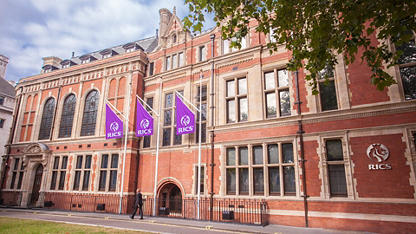
On Wednesday 17 October, the Royal Institution of Chartered Surveyors and the Urban-Housing Intergroup of the European Parliament organised a seminar to launch the latest book in the RICS Real Estate Issue series titled Urban Sprawl in Europe – landscapes, land-use change & policy.
To many, the words ‘urban sprawl’ provoke negative thoughts of unplanned, low-density development outside urban areas, eating away at the diminishing parts of nature that are left in Europe.
On the other hand, whatever one wants to call the phenomenon, it can’t be denied that many factors (e.g. demographic change, economic growth and personal preference) induce the dream of many people to ‘sprawl’, even if they don’t see it as such. Can this be controlled? Should it be?
Mr. Jean Marie Beaupuy, MEP and President of the parliamentary Urban-Housing Intergroup, and Ms. Jill Craig, RICS head of policy & public affairs, hosted this well attended seminar with a wide variety of speakers and interesting debates showing the complexity of urban sprawl.
During his introductory remarks, Mr. Beaupuy stated that urban sprawl is one of the major challenges we face in Europe. Between 1990 and 2000, Europe has seen an increase in urban size equalling three times the size of Luxembourg. In other words, Europe is sprawling and politicians at all levels have to shoulder their responsibility.
Ms. Jill Craig, RICS head of Policy and Public Affairs, pointed out that although everybody seems to have a feeling on what urban sprawl is, the lack of a clear definition makes a proper discussion difficult. Is sprawl good? Is sprawl bad? Is sprawl a phenomenon that simply exists and do we have to learn how to deal with it?
Four speakers addressed these questions from very different angles:
- Urban Sprawl in Europe
Professor Chris Couch, MRICS – Professor of Urban Planning, Liverpool John Moores University and co-editor of the book “Urban Sprawl in Europe”
- Regional Policy and Urban Spatial Development
Ms. Sylvie Harburger – Senior Policy Analyst, Urban Actions Unit, DG Regio, European Commission
- Urban Sprawl in Eastern Europe, the Budapest example
Mr. Pál Baross, FRICS – ING Real Estate and Chairman of RICS Hungary
- Sustainable Suburbs
by Mr. Indy Johar – Director of 00:/ architects
The presentations are available for download at the right-hand side of the screen, along with other information including how to buy the book and the “sustaining our suburbs” intermediate report, on which co-author Mr. Johar based his presentation.
The following pages of this article present more detail about the presentations given at the conference.
RICS would very much like to thank Mr. Beaupuy, his assistant Ms. Alexandra Leuliette and the Urban-Housing Intergroup for the excellent cooperation on what was a highly successful seminar.
RICS actively encourages the European debate on cities and housing, and welcomes further discussion on relevant topics such as urban sprawl.
For more information, please contact Sander Scheurwater at sscheurwater@rics.org.
Professor Chris Couch, MRICS
Professor of Urban Planning, Liverpool John Moores University
‘Urban Sprawl in Europe’
Mr. Couch is a co-editor of the latest book in the RICS/Blackwell Real Estate Issues series, titled ‘Urban Sprawl in Europe – landscapes, land-use change & policy’.
This book is based on an EU Framework V research project programme on ‘City of the Future, entitled ‘Urban Sprawl: European Patterns, Environmental Degradation and Sustainability’, with the acronym ‘URBS PANDENS’.
Articles and books on urban sprawl are almost always about the United States. However, there are several differences between the US and Europe that justifies a study on urban sprawl in Europe. These differences include:
• The philosophy of government and governance;
• The structure of local government;
• The strength of planning systems;
• Attitude towards urban sprawl;
• Geography of the cities and the scale of urban problems.
One of the main issues was the definition of urban sprawl. Most definitions deal with the pattern of land use. These definitions revolve around phenomena such as low density housing, single use residential areas and discontinuity of the urban area.
Professor Couch and his colleagues looked at urban sprawl as a process rather than a pattern. This can be shown in a graph with a density gradient. A density gradient moving outward in parallel can be seen as urban growth, whereas a gradient becoming less steep can be seen as urban sprawl. Compare it to a sandcastle. As it gets in contact with water, it spreads out whilst the amount of sand stays the same.
Explanations for urban sprawl are varies and include globalisation, energy pricing, transport pricing, social attitudes, nature of local government systems, local geographies, local economic structures and individual behaviour of households and firms.
The book contains interesting case studies from European towns like Liverpool, Stockholm, Leipzig, Warsaw, Ljubljana, Vienna and Athens. These case studies show a wide variety in the kinds of sprawl, which the editors of the book set into four categories:
• Infrastructure related sprawl;
• Sprawl in the post-socialist city;
• Sprawl in declining urban areas;
• Life-cycle driven sprawl (including 2nd homes)
According to Mr. Couch, we can speak of urban sprawl in Europe, but we cannot speak of European urban sprawl. There are differences in different countries and regions and we have to acknowledge there are many drivers of sprawl across Europe, taking place in many different planning cultures.
Policies need to recognise this multiplicity of types and causes of sprawl and the variety of urban situations.
Ms. Sylvie Harburger
Senior Policy Analyst, Urban Actions Unit, DG Regio, European Commission
‘Regional Policy and Urban Spatial Development’
Ms. Harburger focussed her presentation on the urban dimension of EU policies and the relation between the EU structural funds and urban sprawl. Over the past decade, the European Commission has actively promoted the concept of sustainable urban development. Keeping in mind all aspects of sustainability (economical, social and environmental) Ms. Harburger concluded that urban sprawl is not a form of sustainable development.
Besides EU regional policy and the structural funds, there are many EU policies that are relevant for the urban environment in general and urban sprawl in particular. environment, energy and transport are but a few of the fields having a direct impact on urban sprawl.
In May of this year, the European Commission published a guide titled ‘The Urban in Community Policies for 2007-2013’. This guide puts each EU policy in an urban context, and specifies relevant financial resources, exchange mechanisms and information sources available. The intention of the guide is to assist various stakeholders in urban development. RICS has already published a series of articles on this website, where this EU document is available for download, and the various policy sections are described more into detail. For more information, please click here.
Ms. Harburger further made a link to a report on urban sprawl published by the European Environment Agency (EEA) where it could be read between the lines that the EU structural funds might actually be contributing to urban sprawl!
A link was made between social polarisation and spatial segregation, where urban sprawl seems to be a factor.
The new Cohesion Fund period of 2007-2013 sees a mainstreaming of the urban dimension, formerly conducted under the URBAN programme. In total, almost €350 billion of European money is available for cities and regions, although urban policy is not a European Union competence under the terms of the treaties.
Whilst funding for housing has become available for new Member States only, several EU initiated actions can help fight urban sprawl, for example in the fields of social exclusion, mobility, demographic change, safety and urban regeneration.
URBACT II, the Regions for Economic Change initiative and the financial initiative JESSICA are a few examples of EU initiatives directly affecting the urban environment.
Legislative measures and spatial planning can contribute to curbing urban sprawl.
Mr. Pál Baross, FRICS
ING Real Estate and Chairman of RICS Hungary
‘Urban Sprawl in Eastern Europe, the Budapest example’
Mr. Baross used his professional and personal experience to show the participants what has happened to Budapest in the last few decades, in particular after the fall of the communist regime. Many items were recognisable from the ‘Urban Sprawl in Europe’ book, where tables show that Budapest is one of the cities which is declining in population, whilst at the same time suburbanising rapidly, especially after the communist collapse.
Budapest can be described as a ‘primate city’ in Hungary, meaning it is far bigger than the other main urban areas. However, Budapest is showing a negative growth and is losing population very fast.
During the 1950s and 1960s, Budapest was expanding rapidly, and the cores city became to encompass surrounding urban areas. As much of the expansion was industry focussed, the result is that today almost 40% of the Budapest area can be characterised as brownfield land.
From the beginning of the ‘90s, a strong decentralisation can be seen, where the regional economic activity encompasses towns as far as 70 kilometres from Budapest. An interesting element was that this decentralisation process affected the richer areas the most.
A classic suburbanisation pattern can be seen where first the people move out of the city centre and start to commute. After the people jobs started to spread, after which amenities (schools, libraries, health facilities, etc.) followed.
One of the key drivers of suburbanisation was the poor inner city housing, especially the large communist panel estates, which comprise about 35% of the housing stock.
Urban regeneration is central to attracting people to the city centre again. The demand is there, what is needed is confidence.
Indy Johar
Director of 00:/ architects.
‘Sustainable Suburbs’
Mr. Johar presented the intermediary findings of a study commissioned by the RICS and the Commission for the Build Environment (CABE) in the UK.
The aim of the research, which should still take about a year to finalize, is to examine the suburban context and discover what policy and practice solutions could be developed to enable suburbs to respond appropriately to the climate change, social cohesion, affordable housing and sustainable development. It is available for download at the right hand side of the screen.
In the UK, the focus has very much been on urban renewal, compact cities and densification. This has led to a dual classification of areas, urban and rural. However, statistics show that about 84% of the people live in areas that can be classified as suburban.
Mr. Johar introduced the term ‘personalised cities’. Suburbs in the UK were originally build around industrial centres, and often born as a project of extended tube- and railway lines. As industry left, jobs and amenities disappeared, leaving unsustainable, car-dependent areas. Today, suburbs are no longer just places where people commute to the centre. People also travel to other suburbs, to rural areas, or more and more to stay home and work.
One of the key issues is the idea of segregation. Not just social and spatial segregation, but segregation generated by mobility.
The mobile elite are able to connect using either finance or mobility to a wider facility of choice. These are also the people who possibly live in virtual neighbourhoods. Friends are scattered around Europe, whilst the next-door neighbour is unknown. Many people are happy with this kind of life and there is nothing wrong with that. However, there are people who live in geographically bound neighbourhoods. This is where the real political challenge lies.
On other issue is density. Instead of dwellings per hectare (which could be empty during the day), we should start talking about population density. And instead of discussion on what would be an ideal population density from environmental and social points of view, we should discuss the perception of density, which can vary considerable.
Furthermore, the issue of the supply chain should be addressed. The last mile from the supermarket to the house counts for 48% of CO2 emissions of food transport. Tackling this would mean addressing the adverse environmental aspect of suburbs, or as some might call it, urban sprawl.
Finally, Mr. Johar talked about the concept of lifetime neighbourhoods. It can take years to get to know your neighbours, and especially for the geographically bound it is important to feel at home in their neighbourhood. As living preferences change throughout a human life, a neighbourhood should offer a diversity of housing models and typologies.
Urban Sprawl in Europe - images of the event