
The risks of bribery, corruption, money laundering, terrorist financing and sanctions violations are global challenges that impact our profession, regardless of geography or industry specialism. This page contains resources to help you meet the requirements under the Rules of Conduct and carry out your practice in an ethical manner, reducing the risks of financial crime.

The 1st edition of the standard was issued in 2019 and referred to as Countering bribery, corruption, money laundering and terrorist financing. This standard has now been revised and updated to address the evolving landscape of financial crimes, including emerging issues driven by the rise of new technologies such as artificial intelligence (AI) and the increasing use of digital currency. It also incorporates the latest developments in global trade, including the growing utilisation of natural resources such as gold and timber for trade-based money laundering. These resources are often used in illegal activities like deforestation or unregulated mining to generate illicit funds. These funds are subsequently laundered through legitimate markets via online platforms.

To ensure the updated standard supports members and firms effectively, RICS held a public consultation online from the 25th February to the 22nd April 2025. The Basis for Conclusions document provides responses to the Countering Financial Crime Standard public consultation.

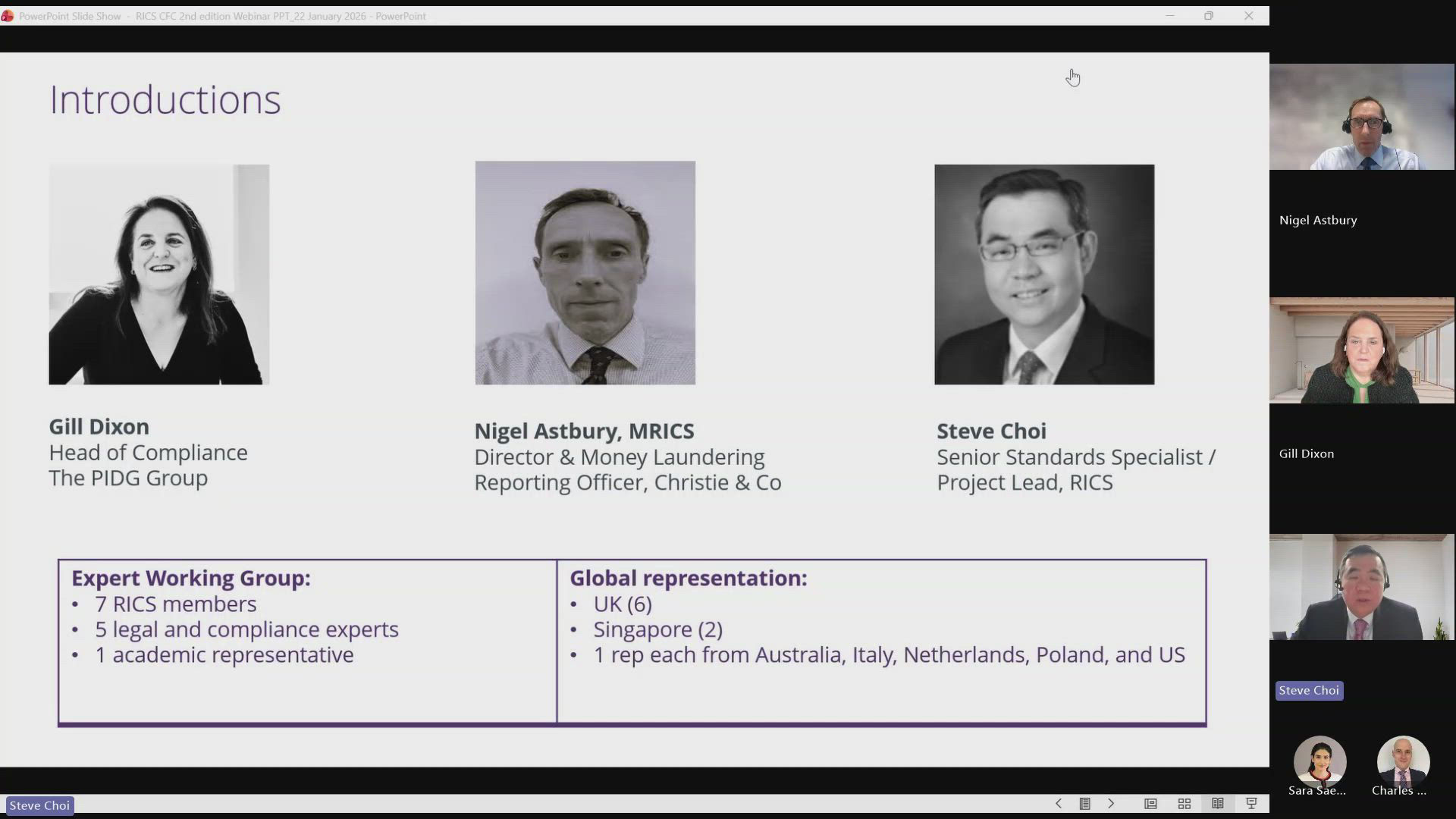
Expert Working Group biographies

Alexander Aronsohn FRICS
Chair

Alexander Aronsohn FRICS

Alexander Aronsohn (FRICS) is a Chartered Surveyor with long and wide-ranging experience of over thirty years encompassing residential asset management, commercial and residential development, rating, national and international valuation and investment. Alexander is the IVSC Technical Director and assists the IVSC Standards Review Board and the Tangible Assets Board on drafting IVS, perspectives papers, presentations, training, and articles. Prior to joining the IVSC Alexander was the RICS Director of Technical Standards.

Alex Ktorides
Chair

Alex Ktorides

Alex joined Bristows in August 2022 and is responsible for all the risk and compliance affairs within the firm. He works closely with the firm’s partners and senior managers to ensure that we do the right ethical things by our people, clients and regulators. Before joining, Alex was a solicitor in private practice, and qualified in 1997. He worked with a number of leading law firms before going in house in 2003. Alex was senior counsel with BDO and led the global risk function at Ince. Alex has written the professional standards for AML and Bribery for the Royal Institution of Chartered Surveyors, in addition to writing many articles and giving presentations, some of which can be found on YouTube.

Gill Dixon
Technical Author

Gill Dixon

Gill began her career in Financial Services and transitioned into Compliance about 20 years ago. Over the past 14 years, she has led Compliance Functions holding the Financial Conduct Authority regulatory functions during this time. Her career has taken her on a journey from Financial Services to other sectors including Oil & Gas, Real Estate, and Infrastructure Development. Her area of specialism and passion is Financial Crime. Gill holds both an LL.B and LL.M degree. In her spare time, she enjoys traveling and participating in marathon running.

Ben Walker

Ben Walker

Ben is a Chartered Surveyor with over 30 years’ experience gained in the fields of valuation, leasing, capital transactions, asset and funds management, working in the UK, France and Australia. He has held various senior positions in private practice, investment banking, a major US corporate and a Big 4 consulting firm. Ben currently lives in Brisbane, Australia, with his wife and 2 sons. He currently works for a privately owned property investment firm headquartered in Sydney.

Giorgia Innamorato

Giorgia Innamorato

Giorgia is an Italian lawyer based in Milan and admitted to the Milan Bar. Giorgia daily advises both Italian and foreign clients in the context of the compliance with AML legislation. In particular, she assists obliged entities in Italy in the preparation of the required internal procedures and protocols for the compliance with AML rules. Giorgia also assists clients when the competent authorities identify violations of AML obligations and defends them when sanctions are imposed, initially before the extra-judicial competent authorities, and, if it is the case at a later stage, before the competent Courts. In addition to her AML expertise, Giorgia also deals with real estate and M&A matters.

Jo Upton

Jo Upton

Jo has been a member of RICS since 2015. Jo is CEO at Pegasi, with responsibility for all residential, commercial, and retail assets under management in Prime Central London, as well as, a 3000-acre arable farm and estate in Essex . Jo has a wide range of responsibilities for companies within a trust, extending to Board positions across the US and horse racing. Jo sits on the Board for the Knightsbridge BID and is Chair for City River Partnership, which plans on pursuing BID status in due course. Jo is an RICS mentor for those pursuing the senior professional route, as well as, a qualified personal development facilitator working with people and horses.

Katarzyna Studzińska

Katarzyna Studzińska

Katarzyna Studzińska is a Compliance Manager at Colliers Poland with over 12 years of extensive experience in compliance. She has a proven track record in designing, implementing and continuous improving compliance processes, including the Anti-Money Laundering area, as well as, digitalization initiatives within this realm. Katarzyna excels in crafting and delivering compliance related trainings, utilizing both live format and e-learning platforms to ensure comprehensive understanding and compliance. She remains committed to driving regulatory excellence and fostering a culture of compliance within the organization and real estate industry. Katarzyna is a member of the Inter-agency Compliance Initiative in Poland, where she collaborates with leading real estate agencies’ compliance professionals to enhance industry standards and practices on the local market. Katarzyna is also a Certified Internal Auditor (CIA) accredited by the Institute of Internal Auditors (IIA). She is a member of IIA Poland.

Kalyani Vasan

Kalyani Vasan

Kalyani is the Financial Crime Compliance Leader for Deloitte Southeast Asia. She has over 17 years’ experience in the financial services sector, having worked in Global Financial Institutions prior to joining Deloitte. She has experience leading and managing projects covering policy and procedure gap assessments, definition of target state operating models (“TOM”), transactions monitoring and sanctions screening model validations, sanctions screening lookbacks, KYC/CDD file validation and remediation as well as defining Sanctions risk assessments and governance frameworks. Kalyani also has extensive experience designing and implementing enterprise wide and product risk assessment frameworks, drafting and implementing financial crime compliance policies and procedures as well as process mapping and re-engineering in various institutions.

Louise Shelley

Louise Shelley

Louise Shelley (PhD) is the Omer L. and Nancy Hirst Endowed Chair and a University Professor at George Mason University. She is in the Schar School of Policy and Government and directs the Terrorism, Transnational Crime and Corruption Center (TraCCC) that she founded. Shelley is a leading expert on the relationship among terrorism, organized crime, and corruption as well as human trafficking, transnational crime, and terrorism with a particular focus on the former Soviet Union. She also specializes in illicit financial flows and money laundering. She was an inaugural Andrew Carnegie fellow. While on the Carnegie Corporation and Rockefeller Foundation Bellagio fellowship, she wrote the book, Dark Commerce: How a New Illicit Economy is Threatening our Future, on illicit trade, the new technology, and sustainability, published by Princeton University Press in November 2018.

Philip Bischop

Philip Bischop

With more than 25 years in the real estate industry, Philip is a trusted advisor currently working as Senior Client Manager at Bouwinvest Netherlands. In his current role as member of the Dutch board of RICS Netherlands, Philip is responsible for the portfolio ‘integrity and ethics’ within RICS Netherlands. It is Philip’s ambition to organise events and publications in order to engage on theme ‘Integrity and Ethics’ in the coming years.

Stephen Williams

Stephen Williams

Based in Singapore, Stephen heads JLL’s Southeast Asia and India Value and Risk Advisory businesses, and heads client engagement for international institutional valuation work across Asia Pacific. Stephen currently chairs the Regional Valuation Governance Board and sits on the Global Valuation Risk Committee. He has been in the real estate industry since 1999, became a Chartered Surveyor in 2004 and was elected a Fellow in 2016. Stephen was previously Head of International Standards, APAC for RICS and was involved in the development and review of several professional standards.

Bribery and Corruption

Corruption involves public officials and private bribe payers, but often also requires access to the financial system, the use of anonymous shell companies and professional facilitators to help launder the proceeds. Far from being a victimless crime, corruption also deprives state institutions of sorely needed resources. Bribery and corruption mitigation controls will typically involve monitoring the activities of your own organisation.

Money laundering and terrorist financing

Money laundering is how criminals change money and other assets into clean money or assets that have no obvious link to their criminal origins. The purchase of property has the potential to be used by organised criminals to launder money due to the amount of money which can be "cleaned" in a single transaction.

Global guidance

Risk-based Approach Guidance for the Real Estate Sector

The Financial Action Task Force (FATF) is the global money laundering and terrorist financing watchdog. This guidance provides real estate professionals with the requisite tools and examples to support the implementation of FATF standards to implement a risk-based approach to anti-money laundering and countering the financing of terrorism.

RICS guidance - Know the red flags

The Red Flag Indicators document outlines the five main categories of red flags that property professionals need to be aware of. These are:

  • the client
  • the parties
  • the source of funds
  • the transaction
  • the instructions
     

When you have assessed the money laundering risks to your business, we recommend that you consider three lines of defence, which are: your front line staff; your policies, systems (e.g. e-verification of passports) and controls; and senior management and internal specialists and audit functions.

Additional useful information and resources

The 2025 UK National Risk Assessment of Money Laundering and Terrorist Financing  assessed Estate Agency Businesses as medium risk for money laundering and Letting Agency Businesses as low risk.  Both Estate Agency Businesses and Letting Agency Businesses were assessed as low risk for terrorist financing.  All professionals working in the sector must be aware of the issues and appropriately trained to identify and report any suspicions of money laundering or terrorist financing.

Money Laundering, Terrorist Financing and Transfer of Funds (Information on the Payer) Regulations 2017 (the MLRs) set out the obligations on businesses and individuals to prevent their services being used for money laundering, terrorist financing or proliferation financing purposes. RICS-regulated firms based in the UK working in Estate Agency, Lettings Agency or Property Management are captured by the MLRs, and must register with HMRC, which is the supervisor for AML activity in the property sector.  Firms who undertake company services or accountancy services in the course of property management also must consider carefully whether they are in scope and take appropriate action to register and comply with the MLRs.

For firms in scope for the MLRs, Senior Management are responsible for the oversight of their firm’s compliance. They can be held personally liable if they don’t take the steps necessary to protect their business from money laundering, terrorist financing and proliferation financing. RICS-regulated firms must also adhere to RICS standards and guidance.

RICS-regulated firms undertaking activity in the following areas must register with HMRC. There are some very limited exceptions which allow some businesses to not register for supervision. However, even if a firm is exempt from formal money laundering supervision, this does not mean that it does not have to be concerned about money laundering risks.​ All firms have a responsibility under the Proceeds of Crime Act 2002 and RICS own professional standards and guidance.

You must register with HMRC if your business carries out any work defined as estate agent activity in accordance with section 1 of the Estate Agents Act 1979 if you act:

  • on instructions from a customer who wants to buy, sell or let an interest in land, in the UK or abroad
  • to introduce your customer to a third party who wants to buy, sell or let an interest in land
  • after such an introduction to secure the sale or purchase of the interest in land

The types of business that must register are:

  • high street or online residential estate agencies
  • commercial estate agencies
  • property or land auctioneers
  • land agents
  • relocation agents, property finders, private acquisitions specialists
  • a sub-agent providing estate agency services to a main estate agency business
  • asset management businesses that also provide estate agency services
  • business brokers or transfer agents brokering the sales or transfer of client businesses to third parties
  • social housing associations that offer estate agency services
  • letting or property management agents that offer estate agency services to landlord customers
  • construction companies (residential property builders) with a sales office on-site, where they act or offer additional estate agency services other than the sale of their own construction properties

  • Letting Agency work is defined in the MLRs as consisting of things done in response to instructions received from a prospective landlord seeking to find another person to let land/property or,
  • a prospective tenant seeking to find land/property to rent, and where an agreement is made for the letting of land/property, for a term of at least one calendar month or more​. The rent must be or equivalent to a monthly rent of 10,000 Euro or more (or equivalent in another currency, such as GPB)​

The types of Letting Agency work that is captured in the MLRs:

  • High street or online residential Letting Agency businesses​
  • Commercial Letting Agency businesses​
  • Land agents that also carry out Letting Agency work​
  • A sub-agent that does Letting Agency work to a principle Letting Agency or Estate Agency business​
  • Asset management businesses that also do Letting Agency work​
  • Business brokers or transfer agents that broker a lettings agreement or arrangement such as the tenancy agreement​
  • Social housing associations that do Letting Agency work ​
  • Property management agents that also do Letting Agency work ​
  • In Scotland, a solicitors’ property centre that also conducts Letting Agency work

There are exclusions set out in the MLRs which may mean that your lettings agency business is out of scope for AML supervision. This provides an exception for firms which are considered as engaging in financial activity on an occasional or very limited basis.​ In order to qualify for the exception, all seven criteria in must be met. ​Unless all the exemptions apply, you should register for supervision with HMRC and seek clarification from them direct if you are unsure.

Real estate, lettings and property management businesses which fall within the scope of the Money Laundering Regulations must register with HMRC. You can sign up to emails and watch webinars from HMRC on their website.  HMRC has issued updated guidance on understanding risks in 2025.

Property Managers will likely handle client money and will also have knowledge of both parties to a transaction, other intermediaries and how a transaction is funded. Property managing agents provide company services or accounting information to clients. HMRC advice clarifies that the scope of activities carried out by some agents will fall within the scope of the Money Laundering Regulations (MLRs) as Accountancy Service Providers (ASPs) and/or Trust or Company Service Providers (TCSPs). To establish whether the activities undertaken by your firm fall within the scope of the MLRs, you will need to think about whether your firm undertakes any of the following:

  • Recording, reviewing, analysing, calculating and reporting financial information.
  • Producing client reports on financial accounts.
  • Giving a customer specific tax advice, including advice on whether something is liable to a tax or duty.
  • Providing material aid or assistance on someone’s tax affairs.
  • Capital allowances computations – providing purely valuation advice in respect of capital allowances is not in scope of the money laundering regulations. However, advice on whether an asset is eligible for capital allowances, the calculation of capital allowances or advice on the tax relief that can be claimed on the asset falls within the definition of an Accountancy Service Provider and AML supervision is required.

  • Acting as company secretary
  • Acting as a director
  • Providing registered office addresses

Valuation is not an activity covered by the money laundering regulations but any firm that provides material aid, assistance or advice on someone’s tax affairs, whether provided directly or through a third party, will need to register for AML supervision. This includes any specific tax advice given to clients, including completing and/or submitting tax returns, advice on whether something is liable to tax, or advice on the amount of tax due. This work is captured by the Money Laundering Regulations which cover accountancy, tax, and trust or company services. Any firm that needs to register for AML supervision for accountancy, tax or trust and company services should investigate whether they should register with a professional body supervisor or with HMRC. There are a number of professional bodies who act as the main AML supervisors for tax and accountancy professionals, and members of professional bodies should register for AML supervision with their professional body. HMRC is the default AML supervisor when no professional body supervisor is available Contact details for tax and accountancy professional supervisors, and HMRC is available here.  The Association of Tax Technicians has also provided advice for their members in relation to AML supervision of capital allowances advisers on their website here.

Sanctions

Sanctions are restrictions put in place by the UN or national governments to achieve a specific foreign policy or national security objective.

Financial sanctions include asset freezes, which:

  • prohibit dealing with a sanctioned person’s assets, including funds and property
  • prohibit making funds or goods available – directly or indirectly – to a sanctioned person
  • place restrictions on sanctioned persons’ access to financial services and markets
     

Many states have sanctions regimes that prohibit or limit dealings with sanctioned people, entities and their funds, with stiff penalties for those who do not comply. RICS expects firms to understand and comply with the sanctions regimes relevant to the jurisdictions that they practice in, and understand the relevance of international sanctions to their obligations under the Rules of Conduct ‘not to facilitate any financial crime’ (Rule 1.12).

Additional useful information and resources

The UK sanctions regime is far-reaching. All UK nationals and legal entities, wherever they are in the world, and all individuals and legal entities operating within the UK, must comply with UK sanctions and have a general obligation to report to the Office for Financial Sanctions (OFSI) any information that would ‘facilitate compliance’ with the regulations. The UK Government has announced significant changes to the UK sanctions regime, which take effect on May 14 2025 and will affect members carrying out sales and lettings activity in particular.

Under the RICS Professional Standard for Countering Bribery and Corruption, Money Laundering and Terrorist Financing, all RICS-regulated firms must check potential customers or clients (or their ultimate beneficial owner) are under any relevant sanctions that prohibit establishing a business relationship with them.

RICS Guidance

In March 2022, RICS updated its guidance intended to support members and firms in the UK to understand their obligations under the Sanctions Regime given the increased risks associated with the Ukraine crisis.