

The future of property valuation and the influence of E(SG) criteria for residential buildings
-
 Email
Email
-
 Facebook
-
 Linkedin
-
 Twitter
-
 Whatsapp
16 January 2026
Shaping sustainable futures: RICS in Europe student competition
“It was my pleasure to moderate the presentation / discussion session as part of RICS in Europe Student Competition - Shaping Sustainable Futures. I was really impressed by the quality of the papers and the presentations that were shared. In both cases the information provided was detailed, well structured and confidently delivered creating interesting points of view, setting an clear platform for consideration and discussion and paving the way for further investigative study. Great work all round!”
John Newton, Chair of the RICS Sustainability Working Group
Construction Services Director, SIS Systemy UK Ltd
With global climate goals accelerating the focus on sustainability, the property sector has increasingly recognised the importance of Environmental, Social, and Governance (ESG) factors. Many property investors are now integrating sustainability criteria’s into their decision making, and regulatory demands around energy efficiency and carbon reduction are continually rising. These energy performance regulations can significantly impact property portfolios and valuations.
For example, in France the LOI Climate et resilience law prohibits rent increases for residential properties with poor energy performance (EPC ratings of F or G), while under the UK MEES regulation, properties are required to meet at least an EPC rating of E to be eligible for rental. Non-compliance introduces liquidity risks, lowers property values, and increases operational costs for tenants, making properties less attractive and harder to let.
Our last year, student competition invited university students to investigate the critical factors influencing energy efficiency in the residential property sector and their impact on property valuations.
To reflect on this competition and its outcomes, we brought together representatives from the two winning student teams alongside John Newton, Chair of the RICS Sustainability Working Group and Sam Rees, Senior Public Affairs Officer at RICS for an open conversation. The discussion, available as a recording below, explored the competition, the students’ research approaches, and why this topic is increasingly critical for the sector.
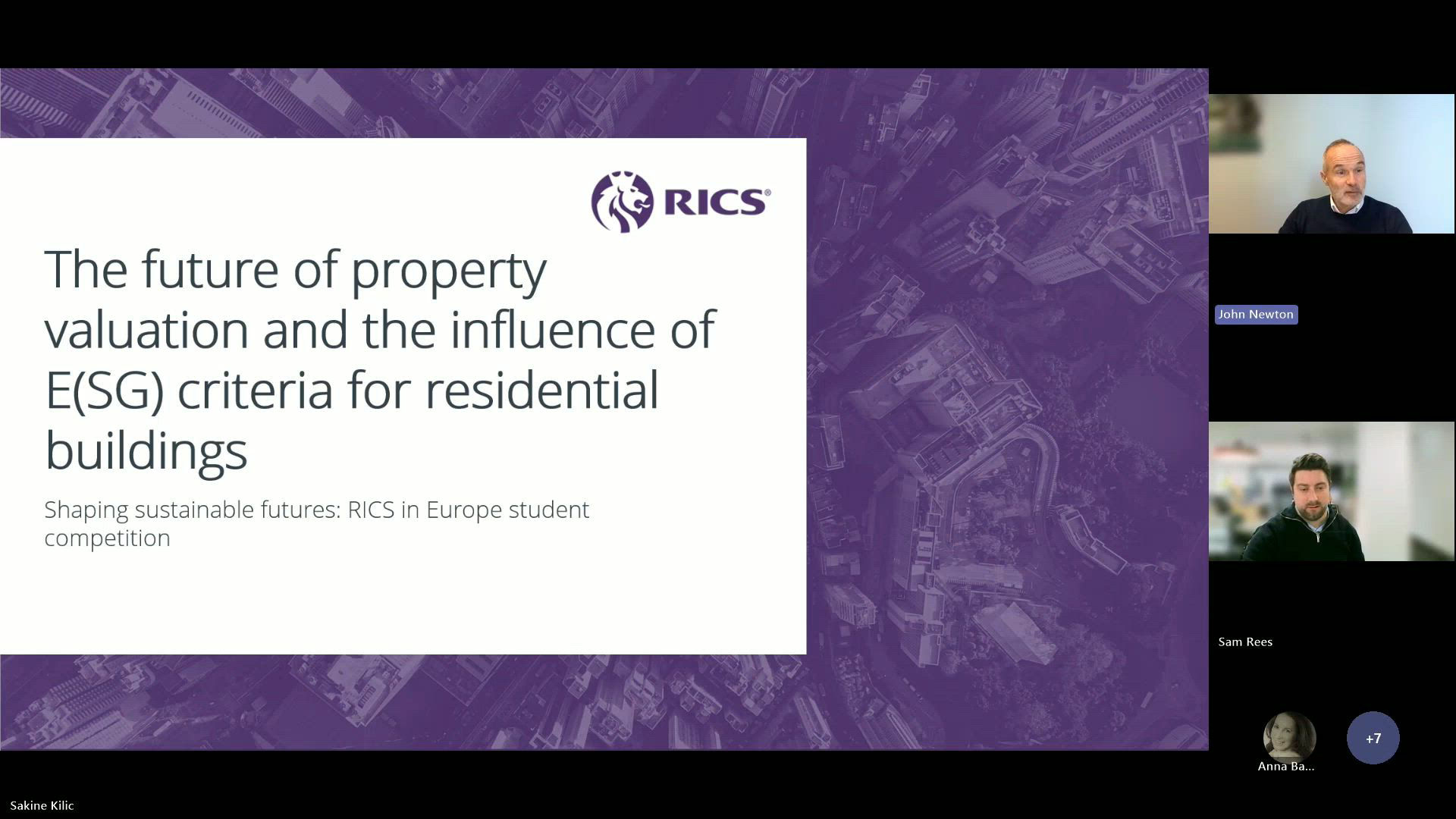
Paper 1: Investigating the Influence of E(SG) Criteria in Residential
By Helena Ciruk, Warsaw University of Technology
Paper provides detailed insight into key factors influencing valuation of buildings in residential property sector. The main focus is put on the energy-related criteria such as energy performance certification, national legislation, CRREM stranding risk dates, building certifications and national legislation. The analysis is performed mostly from the perspective of Polish energy-related laws which are in alignment with EU sustainability directives and such as Energy Performance of Buildings Directive (EPBD) or 2050 climate-neutrality goals therefore presenting also the broader, EU context. Some challenges, such as retrofitting the older buildings are also mentioned. The aim of this paper was to provide priority matrix on the basis of which the most influential factors could be determined. The results implicate that energy-related ones are of the most importance.
Paper 2: House Prices and Energy Efficiency in England and Wales
By Emilija Đorđević, Niccolò Manchinu, Luca Auf der Heyde MRICS and Matthias Popotnig, University of Groningen
The study examines the relationship between residential property prices and both current and potential Energy Performance Certificate (EPC) ratings using a panel of 6.8 million housing transactions in England and Wales from 2014 to 2024. The results show that energy efficiency is not consistently capitalized into housing prices. While properties with an EPC A rating achieve an average 2.9% price premium per square meter relative to the baseline EPC D, properties rated B and C actually transact at modest discounts (–2.3% and –1.2%). Lower-rated homes (F and G) show larger price reductions. Regarding upgrade potential, only the possibility of reaching an EPC A rating is positively priced by the market, particularly for flats; intermediate upgrade paths do not show significant price effects. The results highlight substantial differences across property types and suggest that the relationship between EPC ratings and prices is more complex than previously assumed.
Conclusions and reflections
The conversation with the two winning teams highlighted not only the quality of the research but also the growing importance of sustainability literacy for the next generation of property professionals. Across both papers, a consistent message emerged: energy performance and regulatory compliance are no longer peripheral considerations but central drivers of residential property value.
By bringing together students, academics, and practitioners, the RICS in Europe student competition created a valuable platform for dialogue on how ESG considerations, particularly energy-related criteria, are transforming valuation practice.