


CPD is a requirement for RICS members to continually update their skills and knowledge to remain professionally competent in a constantly changing environment, so they can provide the best possible service.

Continuing Professional Development for RICS members
-
 Email
Email
-
 Facebook
-
 Linkedin
-
 Twitter
-
 Whatsapp
You can now download the new RICS Member App for on-the-go CPD recording.
When actively and positively embraced, lifelong professional learning through continuing professional development (CPD) becomes a foundation for growth. It sharpens skills, deepens knowledge, and strengthens the behaviours that define professionalism. Through meaningful CPD, surveyors can develop, progress and become leaders in their fields, inspiring the next generation of professionals.
The value of CPD
CPD helps surveying professionals understand and build on current best practices, identify risks they, their firms, and clients face, and continually work to improve. This commitment ensures they remain at the forefront of professional excellence.
CPD is your professional toolkit for staying fit to practice, advancing your expertise, and meeting your professional responsibilities. It also plays a vital role in maintaining public trust and confidence in the profession.
Member CPD requirements explained
Recording your CPD
Member CPD resources
Continuing Professional Development
The RICS Rules of Conduct (approved by the Standards and Regulation Board) set out the standards of professional conduct and practice expected of RICS Members. The Rules of Conduct place a professional obligation on members to comply with the continuing professional development (CPD) requirements set by RICS.
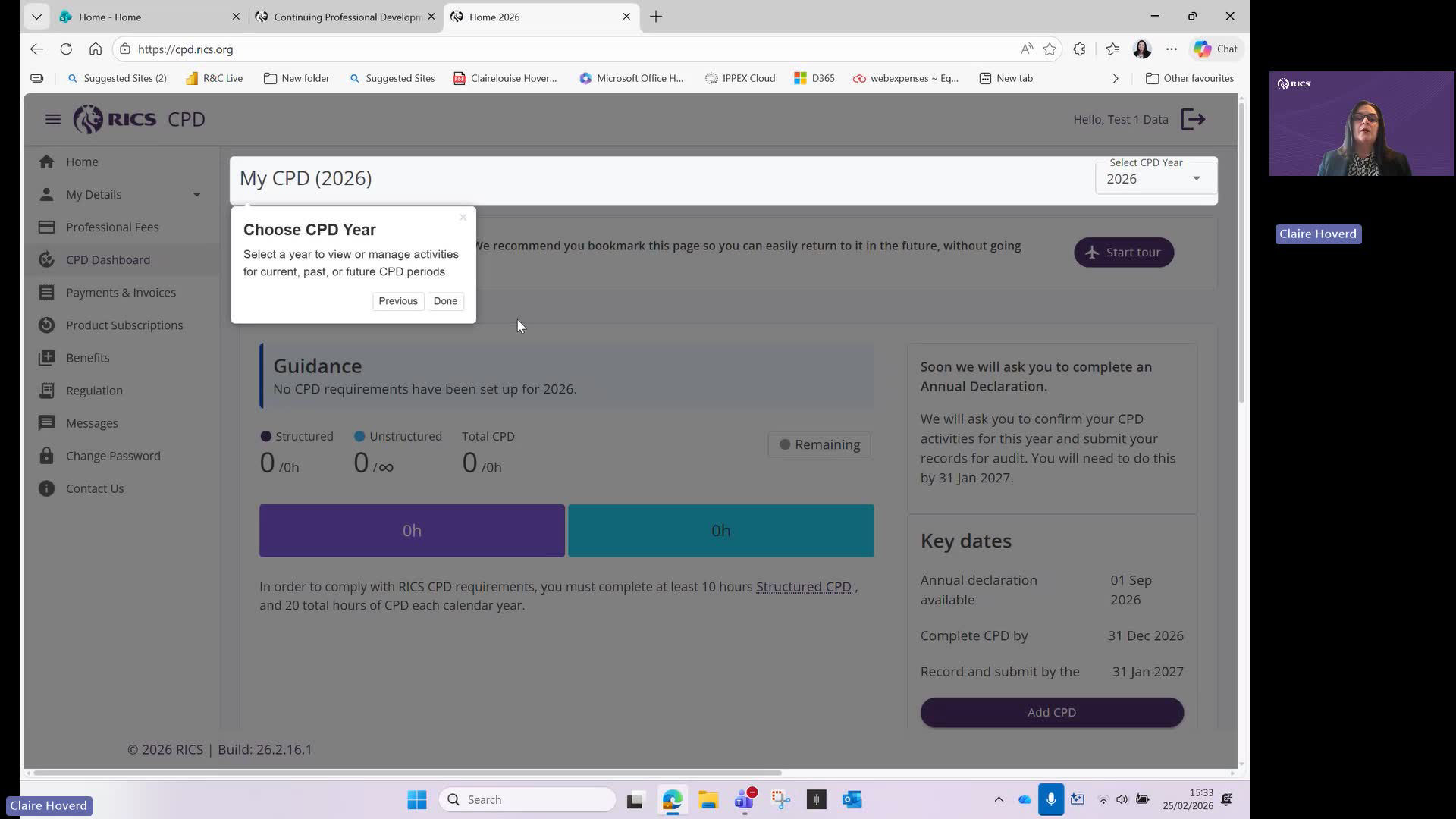
Members must complete a minimum of 20 hours of CPD each calendar year (January-December), with at least 10 hours being structured CPD. You should record your CPD before the end of the calendar year. Full details of all CPD requirements can be found here: Continuing Professional Development.
Planning and reflection: you'll plan your CPD strategically and reflect on how it benefits your practice.
Learning outcomes: record specific learning outcomes for each CPD activity.
Expanded mandatory topics: every three years, complete at least 1 hour of structured CPD on each of these topics:
- RICS global professional and ethical standards
- Sustainability
- AI, data and technology
Greater flexibility: carry forward up to 10 hours from substantial training programmes (like Master's degrees) to the following two years.
Structured CPD includes learning activities with a structured approach where learning outcomes can be easily identified, and where you enhance your knowledge of a particular subject or professional skills in a way relevant to your work. This typically includes webinars, seminars, conferences, lectures, and workshops.
Unstructured CPD is self-managed learning that is relevant to your professional role and has a clear learning purpose, but with a less structured approach to the learning content and/or method. This could include activities such as private study, on-the-job training, or attendance at informal seminars or events focused on knowledge sharing. Reading articles or listening to podcasts would generally count as unstructured CPD.
Following the updates to the RICS CPD rules, the official terminology for members is ‘structured’ and ‘unstructured’ CPD. While some legacy webpages and systems (and candidate pages) may still refer to ‘formal’ or ‘informal’ CPD, the terms used in the CPD Rules and current RICS guidance for members are ‘structured’ and ‘unstructured’. RICS is continuing to update webpages and platforms to resolve these inconsistencies over time. If in doubt – please read the full CPD Rules document in detail: CPD-rules_requirements_Jan2026.pdf. Note the distinction also set out above between member and candidate CPD.
RICS is committed to supporting you in meeting CPD requirements. If you're facing challenges, please contact cpd@rics.org as early as possible. We can:
- help you understand what counts as CPD for your role
- guide you to relevant learning resources: RICS Online Academy | OLA
- explain exemption options if you're facing exceptional circumstances
- provide advice on planning and recording your CPD effectively.
RICS reviews CPD records to maintain professional standards and public confidence. If you don't meet the requirements, you may be found to be non-compliant and may face administrative or disciplinary action.
- We strongly encourage you to reach out for support before missing requirements. Early engagement helps us work with you to find solutions.
Yes. Full or partial exemptions are available for circumstances including:
- retirement (unless you're an APC assessor)
- long-term ill-health or serious incapacity
- family raising, parental/adoption leave, or caring responsibilities
- unemployment or not currently practising
Apply for exemptions through your MyRICS account or contact cpd@rics.org. Exemption requests must be made by 31 December of the relevant CPD year.
- Activity date - when you completed the learning
- Activity type - the format of the learning (e.g., webinar, course, conference, self-study)
- Description of the activity - what the learning covered
- Number of hours - time spent on the activity (minimum 30 minutes per activity, or combine shorter activities)
- Structured or unstructured - whether the learning had a structured approach with clear learning objectives
- Mandatory topic coverage - whether it counts towards your ethics, sustainability, or AI/data & technology requirements
- Learning outcomes - specific, measurable statements describing what you know, understand or can do because of the activity
If, in any given January to December cycle, members undertake a structured programme of study, leading to an externally accredited award (for example a diploma or degree), which is longer than 10 hours and is eligible to be recorded as CPD, they may carry forward up to 20 hours of structured CPD. This can be recorded as up to 10 hours in each of the next two CPD years. Similar arrangements may be allowed for other structured programmes of study, with prior agreement from RICS Regulation. Carry-over is not permitted for activities that commenced before 1 January 2026.
The new CPD rules are only relevant for qualified members AssocRICS, MRICS, and FRICS. Candidates and Students must follow their CPD requirements set by the RICS assessment team.
RICS Member App
The app will make recording your CPD easier and more accessible:
- Log CPD activities on the go from your mobile device
- Track your progress towards annual requirements
- Access your CPD history and records anywhere, anytime
- Profile management to keep your member information up to date
Based on extensive member feedback, we've invested in enhanced digital tools to make CPD planning and recording more accessible, efficient, and beneficial to your practice. The app supports the revised CPD framework's focus on meaningful, quality learning by making it easier to reflect on and plan your professional development.
Yes. You can continue to record CPD through your RICS My Account on the website. The app provides an additional, more convenient option for mobile recording.
No, the app is optional. You can continue using the web portal (RICS My Account) to record your CPD. However, the app offers convenient features like on-the-go logging and progress tracking that many members will find valuable.
The app will be available for both iOS (iPhone/iPad) and Android devices.
The RICS Member App is designed for members with CPD requirements - Associate Members (AssocRICS), Chartered Members (MRICS) and Fellows (FRICS). As a candidate working towards membership, you'll continue recording your APC competencies and experience through the existing APC channels until you qualify.
Reflection and planning
As part of the recording process, you'll complete a section on your professional reflections explaining:
- why you chose the CPD activities you undertook, with reference to your professional role and identified learning needs
- how the CPD you completed has impacted your professional development
- how your CPD informs your plans for professional development in the following year.
Professional reflection helps you identify learning that genuinely advances your skills and practice, moving beyond simply logging hours. It demonstrates how your CPD translates into better professional competence and service delivery—benefiting you, your clients, and the public.
There's no set word count, but your statement should be substantive enough to demonstrate genuine reflection. Focus on quality insights rather than length. The digital recording platform will guide you through the key points to address.
A learning outcome is a specific, measurable statement describing what you know, understand, or can do because of the CPD activity. Recording learning outcomes helps you:
- focus on CPD that delivers real professional value
- demonstrate the impact of your learning
- build evidence of your professional competence.
Weak: "Learned about sustainability"
Strong: "Can now identify three key energy efficiency measures to recommend to residential clients and explain their cost-benefit ratios"
Yes, the revised framework encourages strategic CPD planning aligned with your professional role, responsibilities, and career development goals. Planning helps ensure your CPD is relevant, adequate, and appropriate to your practice—not just meeting minimum hours.


