
Developing the Next Generation of Project Managers
-
 Email
Email
-
 Facebook
-
 Linkedin
-
 Twitter
-
 Whatsapp
02 March 2026

Paul Wilson FRICS
Trainer of Certificate in Construction Project Management
My reflections from delivering the RICS Certificate in Construction Project Management Course
In an industry where the pace of change is accelerating and the complexity of projects continues to grow, the need for highly capable project managers has never been greater. As someone who has worked across construction, estates, and major capital programmes for many years, it’s a genuine privilege to play a small part in supporting emerging professionals through the Royal Institution of Chartered Surveyors (RICS) Certificate in Construction Project Management (CCPM) course.
Why RICS matters
The RICS is more than a professional body, it is a globally recognised authority on standards, ethics and competency across the built environment. For organisations, governments and professionals around the world, RICS represents trust, rigour and consistency.
As a training provider, RICS plays a critical role in:
- Setting international benchmarks for skills, behaviours and technical competence
- Ensuring professional integrity through robust pathways, assessments and CPD
- Raising global standards in land, property, construction and infrastructure
- Supporting lifelong learning through high quality, industry aligned training programmes
This global recognition means that learners on the RICS CCPM course aren’t just gaining new skills; they are developing capabilities aligned with an internationally respected professional framework.
The Course: practical, relevant and globally aligned
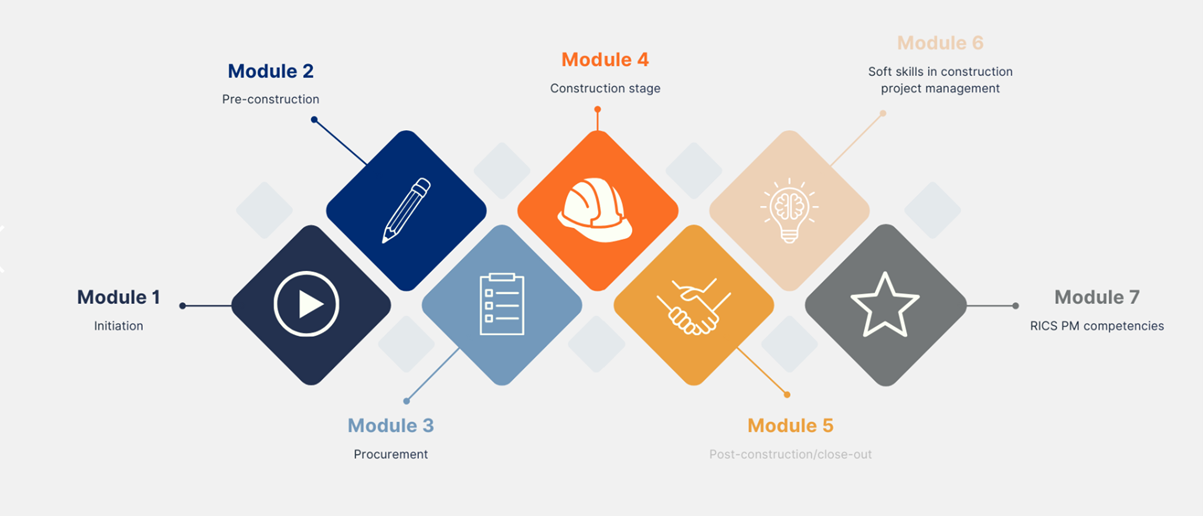
The RICS CCPM course equips learners with a clear understanding of how to manage projects effectively while aligning with the RICS project management competencies recognised around the world. It is a foundation for becoming a chartered professional, or for the practitioner looking for lifelong learning.
The programme blends:
- Core project management principles
- Real case studies rooted in industry practice
- Leadership, communication and behavioural competencies
- Collaborative learning through consolidation sessions and peer dialogue
What makes the course particularly powerful is its commitment to practical application. Learners work through scenarios that mirror the realities of modern project delivery. This allows them to experience how to navigate risk, stakeholders, commercial decisions and programme pressures.
My role as trainer
Delivering this course is incredibly rewarding. It’s fantastic getting to see and work with many future PMs and help them to learn and develop. It is an online course and there is a great global team at the RICS who provide fantastic support (big thank you to Cathie Yin, Jay Wilson, Charu Singh, Anthony O'Kane, Alison Adams - to name but a few of the team).
Here’s what I include when delivering this course:
- Sharing real world insights from decades of project delivery
- Encouraging open discussion and peer learning
- Challenging learners to think strategically and lead confidently
- Helping participants translate theory into practice
- Feeding back on submitted case study exercises
Each module has a consolidation session to work collaboratively and to share practical experience and to bring the theory to life. The online polls we use have proven to be a real success for getting real time thoughts and experiences from the learners.
What participants gain
By the end of the programme, I hope that the learners gain:
- Confidence in project delivery
- Ability to navigate complexity with structure and clarity
- Communication, leadership and problem solving skills
- Professional judgement grounded in real world application
And importantly, they join a global professional community committed to raising standards across the built environment.
The bigger picture
The RICS plays an essential role in shaping the future of our industry by ensuring that professionals worldwide are equipped with the right skills, ethics and standards. The CCPM course is one part of that global mission and aims to create capable project managers who can lead with clarity, integrity and strategic thinking.
Every cohort brings new perspectives and new energy, and every time, I’m reminded why investing in professional development is so vital to the future of the built environment. The diversity of learners is both refreshing and inspiring in a historically traditional and slow to change industry.
If you're interested in strengthening your project management capability or supporting your team to do the same, I’d be happy to share more about the programme and how it can support your growth.