

RICS at the Sustainable Buildings and Construction Summit (SBCS) 2026
-
 Email
Email
-
 Facebook
-
 Linkedin
-
 Twitter
-
 Whatsapp
27 May 2026
The challenge for the built environment has shifted to the immediate need to turn climate ambition into credible action.
That was the unified message at SBCS 2026, a global summit co-organised by the United Nations Environment Programme, the Global Alliance for Buildings and Construction, and the Centre for Worldwide Sustainable Construction at the Swiss Federal Institute of Technology in Lausanne, Switzerland, where RICS joined policymakers, researchers and industry leaders in April.
With buildings and infrastructure remaining a significant source of carbon emissions and resource use, the summit focused on what it will take to close the gap between climate goals and practical, life cycle decision-making to promote mitigation, resilience, circularity, and biodiversity. RICS members continue to lead this delivery, closing the gap by applying professional standards, data, and expert judgment to drive consistent results across different markets.
A milestone moment, launching CLEAR
SBCS 2026 saw the launch of the Coalition for Life Cycle Emissions Alignment and Reporting (CLEAR), announced in the summit plenary.
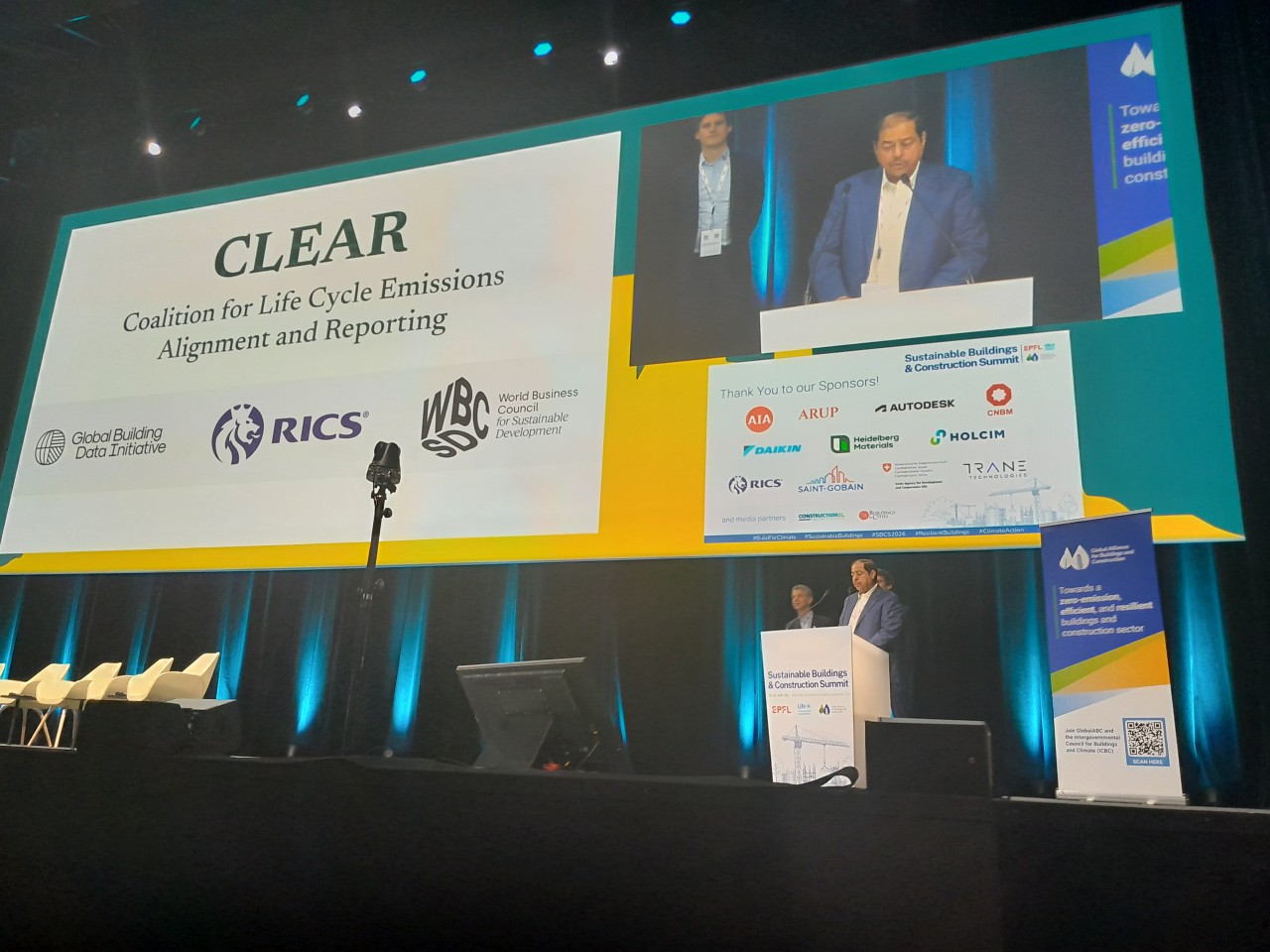
The coalition has been created to bring greater consistency, transparency and comparability to the measurement and reporting of whole-life carbon emissions across the built environment.
It was founded and led by RICS, in partnership with the World Business Council for Sustainable Development (WBCSD) and the Global Building Data Initiative (GBDI). It also features collaborators from across the built environment, including from the construction, technology, and product and materials sectors.
CLEAR builds on RICS’ leadership through the Whole Life Carbon Assessment standard and related initiatives, supporting aligned data, validated tools and a shared ecosystem that can be used across markets. Its aim is straightforward but essential: to make carbon information decision-ready, credible and accessible, enabling action at scale to overcome fragmentation.
For more on CLEAR, the organisations involved and its goals, visit the coalition’s landing page.
Connecting standards, data and digital systems
RICS co-led two summit workshops exploring what it takes to make carbon accounting, data and digital systems aligned, consistent, and fit for real-world delivery.
One of these was a workshop on Minimum viable carbon accounting principles that work for all, co-led with partners including the GBDI, Autodesk, Rocky Mountain Institute, WBCSD, Buildings Performance Institute Europe, and the Carbon Leadership Forum.
The session addressed a central challenge. While whole-life carbon accounting is increasingly expected, fragmented approaches across regions limit comparability and slow adoption. To address this, participants defined a core set of minimum viable principles that can support early-stage design decisions, procurement and carbon management. These included clear system boundaries, transparent assumptions, and shared, industry-average data standards. The emphasis was on clarity, usability, and trust, enabling credible decisions today while maintaining flexibility for continuous improvement.
These themes continued in the workshop on Enabling a sustainable built environment through data, digital systems and AI, co-led by RICS alongside Autodesk, TNO-CIB, Kompas, TU Dublin, and Tampere University, with support from Siemens and the UK Department for Energy Security and Net Zero.
Participants explored how digital tools and AI can optimise the asset life cycle, provided they are underpinned by standardised, interoperable data and clear governance. Technology alone cannot resolve fragmentation; poor data quality, misaligned assumptions and disconnected systems continue to undermine confidence and limit adoption.
Across both workshops, professional standards, validation, and collaboration emerged as essential foundations. With these in place, AI and digital systems can significantly accelerate delivery; without them, they risk reinforcing inconsistency. Ultimately, the sessions reinforced CLEAR's vital role in connecting standards, data, and digital systems to deliver consistent, decision-ready sustainability information at scale.
Beyond the workshops
Across the summit programme, RICS contributed to sessions spanning circularity, product carbon data and strategic collaboration.
On circularity, discussions centred on prioritising retrofit-first approaches, including reusing materials where possible. This included a required mindset shift that views materials as long term resources rather than waste to support more sustainable planning, reduce environmental impact and limit unnecessary expenditure for firms.
For product carbon data, common challenges were identified at both firm and system levels. These included uneven access to data, fragmented standards, and inconsistent procurement and policy approaches. Addressing these challenges will require a common language and infrastructure, with recommended solutions including the wider adoption of environmental product declarations, product carbon footprints and emerging digital product passports.
RICS also participated in roundtables on global collaboration. These explored the impact that cross-sector and cross-business processes can have. Approaches such as ecosystem mapping, for example, can improve carbon management and understanding carbon as a resource to support better planning and more adaptive responses.
These discussions reinforced the importance of collaboration over competition. Addressing complex challenges across carbon, materials, data and delivery requires shared infrastructure, aligned incentives and collective leadership across sectors and regions.
What this means for the profession
SBCS 2026 reinforced that alignment and delivery are a critical gap for the built environment and that standards, reliable data and professional competence are essential to closing it.
Equally clear is the need for a globally inclusive approach that supports action across different regulatory, economic and technical contexts.
In practice, that means members applying global standards on live projects, assuring and improving the quality of carbon and cost data through collaboration, and providing prudent advice to clients and public bodies on practical decarbonisation pathways.
Looking ahead, from SBCS 2026 to COP31
The summit marked progress, not an endpoint. Momentum is now building toward COP31 in Antalya, Türkiye, where buildings and construction will again be firmly on the global climate agenda.
RICS will continue to contribute through its standards, guidance, and global partnerships, including the ongoing development of CLEAR, whole-life carbon work, and the integration of data, digital systems, and AI across professional practice.
As expectations continue to grow, our focus remains the same: supporting our members to deliver a built environment that is low-carbon, resilient and circular, creating long-term value for society, the economy and the planet.


