

Our governance structure
Under the Royal Charter, RICS’ governing body is Governing Council, which is responsible for approving the strategy and overseeing the direction and performance of RICS and the RICS Group. Governing Council is supported by a number of expert boards and committees populated by active RICS members and independent non-executives to which it delegates responsibilities.
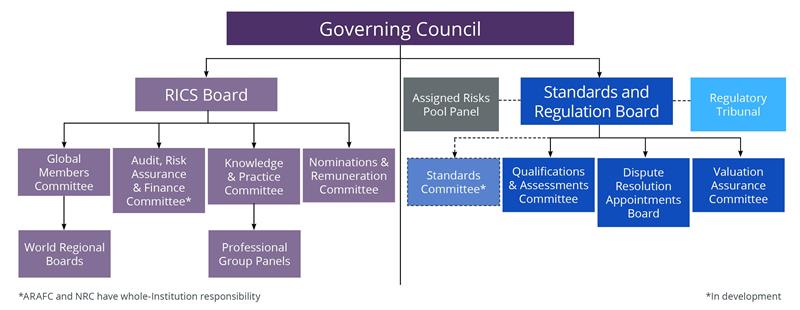
As RICS is an independent regulator, there is a separate Standards and Regulation Board (SRB) that oversees the standards and regulations functions at RICS. SRB is independent from the RICS Board but is ultimately accountable to Governing Council, although it is not directed by them.
The governance structure of RICS as at 31st December 2024 is:
RICS’ officers
RICS’ officers for the period covered by this report are the President, who chairs Governing Council, the President Elect and the Senior Vice President. The Senior Vice President role is elected each year by Governing Council following a rigorous assessment process overseen by the Nominations and Remuneration Committee. More information about the election process can be found Senior Vice President elections.
On 1 January of each year, the newly elected Senior Vice President takes up their role, the person who was the Senior Vice President in the preceding year becomes the President Elect and the President Elect of the preceding year becomes President.
The following officers were in post during 2024
| President | Tina Paillet | From 1 January 2024 |
| President-Elect | Justin Sullivan | From 1 January 2024 |
| Senior Vice President | Nick Maclean | 1 January 2024 |
Governance body members
All governance body members are required to participate in a full induction following their appointment as an RICS non-executive and raise any conflicts of interest at the start of each of their meetings. If a conflict of interest or a perceived conflict of interest arises that could affect the integrity of the decision-making, appropriate safeguards are employed to ensure these conflicts are mitigated.
Annual General Meeting (AGM)
All members are entitled to attend the AGM in order to:
- participate in voting for the appointment of the independent auditor for the next financial reporting period
- receive the most recent annual report and accounts
- receive an update on corporate and financial performance for the most recent financial reporting period.
In 2024, the meeting was held on 27 June and was a hybrid meeting, with members attending in person and remotely.
Governing Council
Governing Council is the governing body for RICS. Ultimate responsibility for RICS rests with Governing Council, which has power to act in all matters in the name of RICS. Governing Council sets the vision for RICS and is responsible for articulating the strategy to achieve this vision. Its powers are set out in RICS Bye-Laws, which are approved by the Privy Council and the membership. The primary duties and functions of Governing Council are:
- being accountable for the overall governance framework of RICS
- setting the strategy and vision of RICS
- overseeing the delivery of that strategy
a. holding RICS Board to account for the effective performance of the professional body
- overseeing the effective delivery of standards and regulations by the Standards & Regulation Board
- ensuring that RICS remains sustainable and can achieve its public interest purpose
- agreeing changes to RICS’ constitutional documents.
Governing Council holds scheduled meetings at least every quarter, and its annual schedule includes an in-person strategy meeting and an in-person oversight meeting. Governing Council also holds special meetings as required to deal with specific topics and in the event of urgent matters. During the 12-month reporting period, Governing Council met six times.
Key items dealt with by Governing Council during the financial reporting period included the following.
- Governing Council composition. Approval of amendment to Regulations to enable three additional seats to be appointed to Council to be filled by persons with specific expertise, such as legal or accountancy qualifications.
b. Governing Council election. Approval of changes to Regulations and Standing Orders to enable members to stand for up to two seats and to enable former Council members to be elected to serve additional terms on Council subject to stipulations regarding maximum duration and minimum break between terms.
c. Election of Senior Vice President for 2025. Endorsement of process improvements to strengthen appointment panel diversity, streamline application mechanics and enhance communications to increase reach to the membership.
- Subscriptions. Approval of 2025 subscriptions framework, including 3.5% increase in the UK MRICS subscription fee for 2025.
- Concessions. Review and approval of concessions framework for 2025 based on retaining working part time concession for disadvantaged groups. Commissioned full review of concessions to be undertaken in 2025 ready for implementation in 2026.
d. Budget and business plan 2025. Approval of RICS 2025 business plan and budget as recommended by RICS Board and SRB, following detailed review and challenge.
- Corporate measurables. Ratification of 2024 corporate objectives, key results and performance measures.
- Transformation. Monitoring of progress on the RICS transformation programme.
e. Entry and assessment consultation. Review of the final SRB report and plans to ensure effective implementation of the consultation recommendations, including discussion of implications for entry pathway options such as sustainability.
f. Diversity, equity and inclusion. Supporting DEI strategy, with focus on attracting a diverse next generation, including endorsing formation of DEI advisory group to support regional DEI representatives.
- Sustainability. Monitoring progress in raising RICS’ profile in leadership on sustainability, including adoption of whole life carbon assessment standard and related commercial product development.
- Strategy. In addition to focus on implementing the Future Foundations strategy, Council conducted strategic brainstorming sessions with particular focus on achievement of RICS vision for 2030-2035.
- Membership engagement. To enhance transparency and engagement with the wider membership in Council meetings, a mechanism has been introduced for members to submit questions to be considered and answered by Council at each of its meetings. Council also monitored member experience actions to enhance value for members, including supporting the UK ‘shaping the future tour’ and attending regional boards and other events.
The composition of Governing Council comprises up to 28 seats, namely three elected members of the Presidential Team, six elected Professional Group seats, thirteen elected Geographic seats, one elected Next-Generation seat, one appointed Senior Independent Governor, one appointed Independent Member, and up to three Appointed Members with expertise in specific areas. Council composition also included a US Market seat until November 2024.
There were 21 members of Council at 31 December 2024 due to four vacant elected seats following the 2023 Council elections and pending appointment the Appointed Members. With effect from 1 January 2025 there were 26 members of Council due to one vacant elected seat following the 2024 Council elections and the appointment of two Appointed Members. The one vacant elected seat was filled by interim appointment for six months with effect from 12 March 2025.
The table below sets out the composition of Governing Council during the 12-month financial reporting period that ended on 31 December 2024, those Council members who vacated their seats during the reporting period, and changes to composition since 1 January 2025.
Composition of Governing Council as at 31 December 2024
Tina Paillet FRICS | President - 1 January 2024 until 31 December 2024 |
Justin Sullivan FRICS | President Elect - 1 January 2024 until 31 December 2024 |
Nicholas Maclean OBE FRICS | Senior Vice President - 1 January 2024 until 31 December 2024 |
Elizabeth Peace CBE | Senior Independent Governor |
Gurpreet Dehal | Independent Member |
Vanessa Curtis FRICS |
|
Johanna Gill MRICS |
|
Andrew Gooding FRICS | Until 31 December 2024 |
Birgit Hempel FRICS |
|
David Hourihan FRICS |
|
Gordon Johnston MRICS |
|
William Jones FRICS | Until 31 December 2024 |
Kenneth Kwan FRICS |
|
Steven Latta MRICS |
|
Jonathan Milner MRICS |
|
Alexia Nalewaik FRICS | Until 26 November 2024 |
Sunny-Thomas Obasuyi MRICS |
|
Colin Uche Obi FRICS |
|
Michael Peer MRICS | Until 31 December 2024 |
Blane Perrotton FRICS |
|
Simon Radford FRICS |
|
Christopher Seymour FRICS | Until 31 December 2024 |
Changes to Composition of Governing Council since 1 January 2025
Justin Sullivan FRICS | President from 1 January 2025* |
Nicholas Maclean OBE FRICS | President Elect from 1 January 2025 |
Maureen Ehrenberg FRICS | Senior Vice President from 1 January 2025 |
Stephen Ballesty FRICS | From 1 January 2025 |
Victoria Clapp FRICS | From 1 January 2025 |
Alison Cosa FRICS | From 1 January 2025 |
Jason Hardman MRICS | From 1 January 2025 |
Graham Jones FRICS | From 1 January 2025 |
Jagath Keerthisooriya FRICS | From 1 January 2025 |
Lynda Rawsthorne FRICS | From 1 January 2025 |
Richard Cass MRICS | Interim Member from 12 March 2025* |
Rosalyn Schofield | Appointed Member (Legal) from 1 January 2025 |
Darina Armstrong | Appointed Member (Accountancy/Finance) from 1 January 2025 |
* The Professional Group Seat for Building Surveying & Building Control (vacant following the 2024 Council elections) was filled by interim appointment for six months with effect from 12 March 2025, by use of the President’s powers in consultation with the Nominations and Remuneration Committee under the Standing Orders, having regard to the strategic importance of the seat in 2025.
The Chair of the RICS Board, the Chair of the Standards and Regulation Board, and the Committees Chairs reporting into the RICS Board (ARAFC, NRC, GMC, KPC, DEI, Sustainability) were invited to attend the annual oversight or other Governing Council meetings.
Standards and Regulation Board (SRB)
Purpose of the Board
The Standards and Regulation Board (SRB) delivers independent professional regulation for RICS, acting in the public interest to uphold standards. It strengthens trust and confidence in the profession through:
- rigorously applying the principles of better regulation and maintaining regulatory autonomy
- setting and upholding the standards of entry and assessment to the profession
- responsibility for the maintenance of professional standards, including approving technical standards, setting conduct standards (including the RICS Rules of Conduct) and developing regulatory policy
a. developing, setting and upholding the professional standards of RICS’ Dispute Resolution Service. It is responsible for the appointment of the President’s panel of dispute resolvers, education and accreditation of alternative dispute resolution (ADR) qualifications and the administration of disputes, as well as promoting alternative mechanisms of dispute resolution
- using targeted, proactive regulatory compliance, enforcement and assurance activities to regulate RICS members and RICS-regulated firms
- working with the profession, the public, external stakeholders and global agencies to share intelligence and lead regulatory best practice
b. providing assurance to Governing Council that the Regulatory Tribunal and its processes are operating effectively for consideration of cases involving serious allegations of failing to adhere to the Rules of Conduct and incompetence against RICS members and RICS-regulated firms.
SRB leadership and independent regulation
The independently-led SRB provides assurance to the profession, public and stakeholders that RICS members and RICS-regulated firms meet professional standards, including those set out in RICS’ Rules of Conduct. The SRB leads the development of a consistent global regulatory strategy and oversees operational delivery across all world regions where RICS members operate.
The SRB oversee the Regulatory Tribunal, which acts at arm’s-length from RICS. The Tribunal is independently led by Presiding Chair, Alexandra Marks CBE, who reports to the SRB. The Regulatory Tribunal consists of independent and RICS members, who sit as panels of three to make disciplinary and regulatory decisions, or on their own as single member decision makers on certain types of cases.
The SRB and SRB Executive work closely with the membership body in RICS but ensure its independence through leadership, staff reporting lines and decision making, ensuring effective implementation of the RICS Regulatory Framework. The SRB is supported by the SRB Executive and staff teams, as well as delegating some of their function and responsibilities to SRB subgroups including the Dispute Resolution Appointments Board, Qualifications and Assessment Committee, Valuation Assurance Committee and ‘task and finish’ groups including the Professional Standards Steering Group, Entry and Assessment Steering Group, Continuing Professional Development Framework Steering Group and pilot Consumer Working Group.
Interim SRB to permanent SRB by May 2024
Following the resignation of the former SRB Chair in late June 2023, RICS appointed an interim Board, which was in place from 24 July 2023 to May 2024. The former interim Chair Nigel Clarke was permanently appointed on 4 December 2023 and completed his recruitment and induction of the new members of the Board in May 2024.
The composition of the Standards and Regulation Board during the financial year for 2024 is
Name | Position | Period |
|---|---|---|
Nigel Clarke | Chair (Independent) | From December 2023 |
Peter Smith FRICS | RICS member | From July 2023 to May 2024 |
Keith Thomas FRICS | RICS member | From July 2023 |
Lynne Livesey | Independent | From July 2023 |
Yo-Hann Tan | Independent | From July 2023 |
Olga Turner Baker MRICS | RICS member | From May 2024 |
Sara Ensor MRICS | RICS member | From May 2024 |
David Fogarty FRICS | RICS member | From May 2024 |
Andrew Reynolds FRICS | RICS member | From May 2024 |
Sukhvinder Kaur-Stubbs | Independent | From May 2024 |
Neil Stevenson | Independent | From May 2024 |
Jonathan Lurie | Independent | From May 2024 |
The SRB staff teams that support the work of the SRB are led by the following members of the SRB Executive.
Chris Alder | Senior Executive Officer, Standards and Regulation |
Christine O’Rourke | Executive Director, Professional Standards |
Ian Jeal | Executive Director, Education and Qualification Standards |
Belinda Howell | Executive Director, Regulation and Assurance Operations |
Dr John Fletcher | Executive Director, Dispute Resolution Services |
Overview from Nigel Clarke, Chair of the Standards and Regulation Board
2024 has been a year of consolidation and progress on some major objectives by the SRB, maintaining RICS’ credibility as a professional body based upon a solid foundation of independent regulation within the Institution.
In May 2024 we appointed ten, high calibre, permanent members to the SRB, recruiting from around 300 applicants. The new members bring a wealth of expertise across a diversity of surveying practice, types of business and regulatory and built environment experience.
I want to publicly thank the members of the Interim SRB for their significant contribution to RICS and the public interest, maintaining rigorous governance oversight and support across the regulatory activities for which we are responsible during a challenging time.
Through a busy year, we were pleased to publish SRB’s first Annual Report and first Risk and Assurance Outlook. Both documents have helped to share the key areas of focus for the SRB, linked to this was our early objective reviewing our regulatory strategy, the operational structure and key areas of regulatory risk. We have set six strategic priorities, focused on enhancing our impact as a regulator and strengthening trust and confidence in the profession. Alongside our ongoing assurance of operational work, these seek to support the profession to improve competence and to better communicate the benefits of regulation to those who rely on the work of our members and firms.
A highlight of my work as Chair of SRB this year has been the opportunity to meet with members at events across the UK, in the Middle East and AsiaPacific. It has been a privilege to hear of their pride in the profession, their appreciation for the value of regulation to their clients and the public, and their feedback and suggestions for improvement.
Many of those conversations have built on the public consultations we have run this year on work taken forward by two working groups on topics of vital importance to the profession – entry and assessment to RICS, and the requirements we set for continuing professional development. These working groups have now reported to SRB and Governing Council, and work is starting in earnest in these areas. Our wholehearted thanks go to the members and specialist independents of those working groups for their diligent and careful approach to developing these ambitious proposals.
RICS Executive Summary by Senior Executive Officer, Chris Alder
Our focus this year as the independent regulator of the profession has been to maintain the high-quality operational delivery that is at the heart of our regulatory delivery, while undertaking ambitious and collaborative work to strengthen trust and confidence in the profession.
Throughout 2024 we reached ambitious milestones in areas such as our review of the Continuing Professional Development framework and model for RICS’ Entry and Assessment, reviewing the Dispute Resolution Service (DRS) governance as well revising a number of important Professional Standards.
Across our operations we have strengthened a range of controls to embed greater resilience and have sought to grow our reach - this has included training a significant number of new assessors, expanding DRS’ influence and introducing further proactive assurance mechanisms. We have taken forward work to improve our current assessment model in parallel with our aspiration to develop a global assessment model that is fit for the future, can be scaled to meet RICS’ intentions for growth and will deliver a first-in-class experience for all involved.
In line with the trend of other professional regulators, 2024 has again seen an increase in the number of concerns raised with us about RICS members and firms. Changes to our processes - focusing on increased support for our professional members and rebalancing resource towards the earliest stage of case triage - have enabled us to maintain performance and improve the quality of our decision- making. Of the increased number of concerns, we have recognised that a significant proportion are complaints about non-RICS ‘surveyors’. Through this year we have strengthened our capability to respond to these, as well as deepening our ability to share intelligence with other agencies.
DRS has continued to provide expertise globally to initiatives that grow recognition of RICS while also having a direct public interest benefit of alternate methods of dispute resolution, as well as taking forward initiatives to encourage greater diversity within this specialism.
While our operational delivery and areas of development have been highlighted, it is equally encouraging that RICS’ influence and recognition continues to grow through SRB’s regulatory thought leadership. At a time of such geopolitical uncertainty and weakening of trust in Institutions, SRB’s ability to convene and drive closer public interest working in the global regulatory arena helps to uphold confidence. Working with global NGOs, multilateral agencies, regulators, business and trade organisations, governments around the world and other professions, SRB’s leadership has helped bring focus to crucial issues of today.
Through 2024 and moving into 2025, these include our development of professional standards on the ethical and responsible use of AI, working alongside global agencies to develop mechanisms to combat corruption and illicit financial flows in the built environment and convening industry leaders on the ethic challenges on the adoption of AI in arbitration.
RICS Board
This section covers the activities of the RICS Board for the financial year from 1 January 2024 to 31 December 2024.
The RICS Board acted under delegated authority from Governing Council during the financial reporting period. The RICS Board was chaired by Martin Samworth throughout the reporting period and continues to be chaired by Martin Samworth.
The main purpose of the RICS Board as set out in the terms of reference is to inform and oversee RICS affairs under delegated authority from Governing Council. The current RICS Board terms of reference will be updated as part of the review of RICS constitutional delegations.
The main duties of the RICS Board under its current terms of reference include:
- approval of a business plan to meet the strategic objectives set by Governing Council while safeguarding RICS’ and the Group’s assets
- assessing and monitoring strategic risks.
- monitoring performance against agreed financial strategy
- preparing the annual report and financial statements
a. approval of the annual report and financial statements.
The main activities of the RICS Board during 2024 comprised the following.
- Quarterly review of operational performance, including 2024 corporate measurables.
- Quarterly review of risk report and strategic risk register.
- Quarterly reports from Board Committees (ARAFC, NRC, GMC, KPC, DEI, Sustainability).
- Standards & Regulation Board interaction – receiving information updates on SRB activities.
- Quarterly report on RICS’ legal entity structure.
- Annual Report & Accounts – approval of ARA for 12-month period ending 31 December 2023.
- RICS letters of support issued in relation to approval of financial statements of subsidiaries.
- External auditors – endorsement of Grant Thornton appointment for 2024 financial year.
- Subscriptions framework – agreement of recommendations to Governing Council for 2025 subscriptions pricing.
- Concessions framework – production of a revised 2025 concessions framework.
- Business plan and budget 2025 – review and approval for presentation to Governing Council.
- Corporate objectives, key results & KPIs 2025 – reviewed for endorsement by Governing Council.
- Entry and assessment consultation – consideration of recommendations and implementation programme, including implications for entry pathway options.
- RICS transformation programme – monitored progress on enabling priority projects, the establishment of a new permanent Executive, and rationalisation of change initiatives into a prioritised framework for 2025.
- RICS Board effectiveness evaluation undertaken by external reviewer, followed by ongoing implementation of review recommendations monitored by the Board.
The RICS Board met six times in the period from 1 January 2024 to 31 December 2024.
The table below sets out the composition of the RICS Board during the financial reporting period from 1 January 2024 to 31 December 2024, and as at the date of signature of the Annual Report & Accounts.
Name | Position |
|---|---|
Martin Samworth FRICS | Chair, Non-Executive RICS Member |
Harriet Kemp | Chair of Nominations & Remuneration Committee, Independent Non-Executive Member |
Louise Brooke-Smith OBE FRICS | DEI Chair, Non-Executive RICS Member |
Frank Hovorka FRICS | Sustainability Chair, Non-Executive RICS Member |
Simon Rawlinson FRICS | Chair of Knowledge & Practice Committee, Non-Executive RICS Member |
Douglas McCormick FRICS | Chair of Global Members Committee, Non-Executive RICS Member |
Kelly Olsen | Independent Non-Executive Member - Digital & Technology |
Elizabeth Peace CBE | Senior Independent Governor |
Justin Young | Chief Executive Officer |
*Mike Driver | Chair of Audit Risk Assurance & Finance Committee, Independent Non-Executive Standing Attendee |
* RICS Bye-Laws currently preclude an Audit Committee member from sitting on the Board, hence Mike Driver is a Standing Attendee pending amendment of the Bye-Laws
Committees
Audit, Risk Assurance and Finance Committee
This section covers the activities of the Audit Risk Assurance and Finance Committee (ARAFC) from 1 January 2024 to 31 December 2024.
The main purposes of the ARAFC under its terms of reference are:
a. oversight regarding financial management and reporting, financial sustainability and the annual reports and accounts
b. accountability for reserves policy, investments and pensions, and
c. ensuring that there is an adequate and effective risk management and assurance framework in place and that these are reviewed to meet the needs of the RICS Board and, where necessary, Governing Council.
The ARAF Committee’s responsibilities are to advise the RICS Board and CEO on:
d. the strategic process for risk, control and governance
e. the accounting policies, the accounts and the RICS annual report, including the process for review of the accounts prior to submission for audit, levels of error identified and management’s letter of representation to the external auditors
f. the planned activity and results of both internal and external audit
g. adequacy of management response to issues identified by audit activity, including external audit’s management letter
h. assurances relating to the management of risk for the Institution
i. the performance of and (where appropriate) proposals for tendering for either Internal or External Audit services and for purchase of non-audit services from contractors for special investigations
j. anti-fraud policies, whistleblowing processes and arrangements for special investigations.
The ARAF Committee met five times during the period of 1 January 2024 to 31 December 2024.
The main activities and areas of focus for the ARAF Committee in 2024 were:
Annual Report and Accounts
In Q1 and Q2 of 2024, the ARAF Committee focused considerable effort on the Annual Report and Accounts, working with both the RICS Finance Team and external audit partner, Grant Thornton. The completed Annual Report and Accounts were submitted to the RICS Board on 16 May 2024 and to the membership at the AGM on 27 June 2024.
ARAF was satisfied that in preparing the financial statements the following requirements had been met:
- Suitable accounting policies had been selected and applied consistently.
- Judgements and estimates were made that were reasonable and prudent.
- Applicable accounting and financial standards were followed, subject to any material departures disclosed and explained in the Financial Statements.
- The financial statements were prepared on a going concern basis.
The ARAF Committee received an update in Q4 of 2024 on the progress of the Annual Report and Accounts for the period ending 31 December 2024, with particular focus on:
- enhancing the year-end process
- reviewing and considering all accounting policies and disclosures to ensure that they remain relevant, in line with IFRS and consistent with like organisations
- reviewing and considering the narrative of the statutory accounts from the perspective of the RICS membership.
Strategic risk management
The ARAF Committee reviewed the Strategic Risk Register in detail at each quarterly meeting, noting feedback from the risk team and wider Senior Executive team on the progress of implementing mitigation measures for each strategic risk. The ARAF Committee also received reports on two deep dives into strategic risks relating to relevance and technology.
Internal audit
Throughout 2024, the ARAF Committee were presented with updates from internal audit partner, Validera, on recent internal audit activity at each quarterly meeting,
accompanied by the executive sponsor of the internal audit to discuss the
recommendations and subsequent actions.
The ARAF Committee also discussed in detail, a report on the validation of the outturn
against the corporate objectives for 2023 to provide assurance to the NRC in their
consideration of FY2023 incentive plan payments.
Management accounts and performance reviews
The ARAF Committee monitored and reviewed the management accounts, and performance against business objectives. The Committee reviewed and endorsed the business strategy and budget for 2025.
Investments
The ARAF Committee reviewed investment performance on a quarterly basis and received a detailed update from investment partner, Mercer, in Q3 of 2024.
The ARAF Committee also considered the institutions reserves position, endorsing recommendations made by the Chief Finance Officer for review and approval by RICS Board.
Policy review
The ARAF Committee reviewed several policies throughout 2024, the policies were reviewed from a finance perspective where applicable but also in relation to risk management, ensuring policies are aligned with internal audit recommendations.
Speak-Up policy (Whistleblowing)
The ARAF Committee received quarterly updates throughout 2024 on the effectiveness, operation and promotion of the Speak-Up policy across the organisation.
The below table sets out the composition of the ARAF Committee from 1 January 2024 to 31 December 2024:
Name | Position |
|
|---|---|---|
Mike Driver CB, FCPFA, FCMA, CGMA | Independent Chair |
|
Peter Lewis MRICS MCMI | RICS Non-Executive Member |
|
Tom Barclay FRICS | RICS Non-Executive Member | Until July 2024 |
Lorraine Gaytten FRICS | RICS Non-Executive Member |
|
Tanya Travers | RICS Non-Executive Member | From October 2024 |
Sarah Walsh | Independent Non-Executive Member |
|
Simon Rose FCCA | Independent Non-Executive Member |
|
Nominations and Remuneration Committee
This covers the activities of the Nominations and Remuneration Committee (NRC) from 1 January 2024 to 31 December 2024.
The main purposes of the NRC under its terms of reference are to:
- oversee the election, appointment and succession planning process, as appropriate, for all governance bodies, the President and the CEO, ensuring that processes are fair, objective and able to identify high-calibre individuals with the right skill sets from a diverse pool of applicants
- oversee the performance evaluation process for all governance bodies, ensuring they are linked to the appraisals for individual governance body members and that there are mechanisms in place to address poor performance and identify mentoring and training needs
- set the remuneration policy for RICS employees at all levels in line with RICS’ long-term strategy, and approve the annual budget available for salary review
- determine and review the remuneration strategy for senior RICS employees to recruit, retain, motivate and engage high-calibre senior employees in order to deliver its business objectives globally, and
- set the total remuneration for the CEO and non-executives and review the remuneration of the executive team and other senior employees that fall within its remit.
The NRC’s responsibilities include:
- approval and oversight of the Global Appointments Model (GAM)
- an advisory role to Governing Council and the RICS Board in relation to matters within its remit
- oversight of elections to Governing Council, including any validation process
- identifying and nominating for approval candidates to fill RICS Board vacancies
- monitoring adherence to the GAM in relation to other governance body appointments
- ensuring orderly succession planning to governance bodies and to the executive team
- ensuring adequate induction and training for all new governance body members
- performance evaluation reviews of Governing Council and the RICS Board
- oversight of the performance evaluation process used by other governance bodies
- approval and review of the appointment process for the CEO
- assessing the diversity and inclusiveness of governance bodies and senior management
- setting the remuneration policy for RICS employees in line with RICS’ long-term strategy
- determining the terms of employment and remuneration package for the CEO
- determining the terms of employment and remuneration for the executive team
- determining the remuneration of non-executive governance body member roles
- approving the design of executive incentive plans, including eligibility and plan rules, and
- approving the overall level of incentive payments and individual bonus amounts.
The NRC met eight times during the period of 1 January 2024 to 31 December 2024.
The main activities of the NRC during 2024 comprised of the following.
Governing Council Elections 2024
A working party of the NRC considered feedback on the 2023 GC election process in the first quarter of 2024. This resulted in a small number of changes to the process. The NRC also provided input into the development of the 2024 election collateral and communications plan and approved the finalised collateral in readiness for opening of the applications to stand for election. Post elections, a small working group of NRC members has been established to review the 2024 elections, with any suggested changes to be recommended to Governing Council in Q2 2025, ahead of the 2025 election process commencing.
SVP Election Process
The NRC reviewed the process for appointing the 2023 and 2024 SVPs and approved small changes to the process for the 2025 SVP election. Saxton Bampfylde were selected as the recruitment firm to support the process. With 23 applicants in total, Maureen Ehrenberg was elected by Governing Council to the position of SVP from 2025. A working group, comprised of NRC and GC members was created to review the process and provide any recommendations for change to Governing Council in 2025, ahead of commencement of the 2026 SVP process.
Appointments
With less recruitment required throughout 2024 in comparison to previous years, the NRC focus has been on increasing the diversity of applications for all governance roles. A workshop session was held in Q1 2024, with continuing monitoring of progress and applications throughout 2024.
The NRC conducted a full review of the Global Appointments Model (GAM) during 2024, which will be completed in 2025, once the ongoing work to review the type of governance and engagement bodies within the organisation is concluded.
Performance evaluation
Throughout 2024, the NRC developed and piloted a performance evaluation process for individuals holding governance roles. This process will be completed by all governance bodies in 2025. Members of the NRC have worked closely throughout 2024 with the Presidential Team and Senior Independent Governor to develop an individual development assessment process for members of Governing Council which is due to be implemented in 2025.
The NRC commissioned an evaluation of RICS Board, conducted by an external evaluation provider and a working group has been established to oversee implementation of recommendations from the evaluation.
Salary Review 2025
The NRC approved the budget for the April 2025 salary review in October 2024, with further consideration to be made in Q1 2025 with the Target Operating Model implementation.
Executive Incentive Plan 2023, 2024 and 2025
On review of the outturn against corporate objectives and the final audited operating result, the NRC approved payout of the FY2023 executive incentive payments. The NRC also set the design, structure and targets for the FY2024 incentive plan and have commenced review of the FY2025 plan for approval in Q1 2025.
Fees for individuals holding Governance roles
A working group, comprised of NRC members, was formed to review non-executive remuneration for those holding governance positions. The working group updated the NRC on progress in Q4 2024 and will be making their full recommendations in 2025.
Other Activities
In addition to the topics covered above, the NRC also participated in the following actions during 2024:
- commenced work on developing skills matrices for governance bodies
- received regular updates on the ongoing work to create a robust evaluation and pay framework
- reviewed and approved the structure of the 2024 market incentive schemes and monitored their effectiveness.
The below table sets out the composition of the NRC from 1 January 2024 to 31 December 2024:
Name | Position |
|---|---|
Harriet Kemp | Independent Chair |
Martin Samworth | Chair of RICS Board, RICS Member |
Fiona Griffiths | Independent Non-Executive Member |
Mary Robertson | Independent Non-Executive Member |
Nick Crofts | Independent Non-Executive Member |
Ashley Hook | RICS Non-Executive Member |
Katie Smith | RICS Non-Executive Member |
Ben Chaston | RICS Non-Executive Member |
Global Members Committee
Previously known as the Membership Services Committee, the Global Members Committee has oversight of the five World Regional Boards - Americas, Asia Pacific (APAC), Europe, Middle East & Africa (MEA) and UK & Ireland, which report into the Committee.
The main purposes of the Global Members Committee, under its terms of reference is to:
- champion the delivery, and ensure the quality and consistency, of member services, experience, engagement, and value
- consider and recommend regional business plans developed by World Regional Boards for approval by RICS Board as part of the overall business plan
- act as a conduit between RICS members, World Regional Boards and RICS Board, to ensure that the sentiments expressed by members and permanent staff of RICS to World Regional Boards, are conveyed to and understood by RICS Board.
Key activities of the Global Members Committee during the year included review of the:
- the global market strategy framework
- market plans
- performance dashboards, budgets, terms of reference and updates of the five World Regional Boards
- member experience framework
- global volunteer recognition programme
- improvements to member communications and the Consent Centre.
The Committee also considered and discussed member subscriptions, CPD framework and the relevance of new pathway/qualifications options relating to sustainability and data/AI/technology. Member satisfaction, retention and growth continued to be key objectives.
The Global Members Committee met 4 times in the period from 1 January 2024 to 31 December 2024.
The table below sets out the composition of the Global Members Committee from 1 January 2024 to 31 December 2024.
Name | Position |
|
|---|---|---|
| Douglas McCormick | Chair | from 1 January 2024 |
| Simon Prichard* | Member and UK & I World Regional Board Chair | |
| Susanne Eickermann-Riepe | Member and Europe World Regional Board Chair | |
| Eric Cheah | Member and APAC World Regional Board Chair | until October 2024 |
| Sanjay Dutt | Member and APAC World Regional Board Chair | from November 2024 |
| Christopher Smith** | Member and Americas World Regional Board Chair | |
| Haroon Niazi | Member and MEA World Regional Board Chair |
The Global Members Committee reports into the RICS Board after each of its meetings and annually to Governing Council at its annual oversight meeting.
* Simon Prichard’s second term ends in July 2025 and a new Global Members Committee Member and UK&I World Regional Board Chair is being appointed.
** Christopher Smith’s second term is also ending in July 2025, and Michael Hardman has been recruited to take over as the new Global Members Committee Member and Americas World Regional Board Chair.
Knowledge and Practice Committee
The Knowledge and Practice Committee works closely with the RICS Knowledge and Practice team and Professional Group Panels to review and support the work being undertaken to achieve the corporate objectives of RICS.
The main purposes of the Knowledge and Practice Committee under its terms of reference are to:
- maintain and develop the knowledge and professional practice of surveying, for the public advantage, by developing, maintaining and promulgating:
- technical standards, associated advice and practitioner information regarding the knowledge and professional practice of surveying
- RICS’ body of education, training and professional development materials, for the different sectors within the surveying profession
- advance industry and public knowledge on relevant, key issues affecting the natural and built environment, amplifying the expertise and voice of the profession, to maximise its influence for the public advantage
- develop and maintain arrangements that ensure RICS’ work is informed and guided by expert insight and member input on practice and market issues, trends and emerging/future professional requirements relating to the knowledge and practice of surveying
- through expert insight and member input, develop and evolve the competences required for APC pathways and ideas for new pathways as and when appropriate ensuring no overlap of role with the Standards and Regulation Board (SRB).
Key activities during 2024
During 2024, the Knowledge and Practice Committee:
- agreed and approved the Knowledge and Practice strategic plan for 2024 and established and inducted the six Professional Group Panels
- established joint working with SRB’s Professional Standards Steering Group (PSSG) and instigated a sub-group to review the standards and practice information programme
- actively consulted on the Entry and Assessment Review and CPD projects
- inputted into conference programmes
- instigated a sustainability sub-group to review knowledge and practice sustainability outputs and plans
- undertook detailed review of detailed review of options for Sustainability qualifications including recommendations to RICS Board.
Key issues during 2024
During 2024 the key issues that the Knowledge and Practice Committee considered were:
- prioritisation of standards programme and ensuring close collaboration with PSSG for the approval of projects
- RICS response to AI and technology and sustainability programme.
- supporting adoption of the Whole life carbon assessment standard into the market
- RICS engagement with UK government and key stakeholders and response to other UK government policy priorities
- current pricing of webinars and other CPD offerings by RICS.
- ensuring wider member engagement and awareness of the work of Knowledge and Practice Committee and Professional Group Panels, through communication campaign
- developments and advising on UK residential including retrofit, home surveys and government regulation of estate agents.
The Committee was supported by 76 members of Professional Group Panels. Their contribution is appreciated.
Professional Group Panel Chairs were actively involved in the production of conferences on behalf of the QS and Construction, Building Surveying, Building Conservation, Telecoms, Planning & Development, Construction and Infrastructure, Land & Property, Commercial Property, Residential Property, Minerals & Waste Management, Rural, Valuation and Fire Safety sectors.
The Knowledge and Practice Committee met 4 times in the period from 1 January 2024 to 31 December 2024.
The table below sets out the composition of the Knowledge and Practice Committee from 1 January 2024 to 31 December 2024:
Name | Position |
|---|---|
Simon Rawlinson | Chair and member of RICS Board |
David Parker | Deputy Chair |
Emma Fletcher | Member and Chair of the Residential Professional Group Panel |
Roger Esson | Member and Chair of the Construction Professional Group Panel |
Nick Knight | Member and Chair of the Valuation Professional Group Panel |
Cliff L’Aimable* | Member and Chair of the Building Surveying and Building Control Professional Group Panel |
| David Sandbrook | Member and Chair of the Land and natural Resources Professional Group Panel |
| Roderick Houston | Member and Chair of the Commercial Property Professional Group Panel |
The Knowledge and Practice Committee reports into the RICS Board after each of its meetings and annually to Governing Council at its annual oversight meeting.
*Cliff L’Aimable resigned with effect from 21 March 2025 and recruitment for a new Committee member and Building Surveying and Building Control Professional Group Panel Chair was underway at the date this report was published.
The Executive team
Chief Executive
The Chief Executive operates in accordance with the Delegated Authority Matrix established and approved by Governing Council. Reporting to the Chair of the RICS Board, they are responsible for the overall management of RICS, the development and implementation of strategy and ensuring that RICS operates effectively.
Executive team
The executive team report directly to the Chief Executive, except for the Senior Executive Officer, Standards and Regulation who reports to the Chair of SRB. The executive team have day-to-day management responsibility for RICS’ key operational areas.
The table below sets out the composition of the executive team during the financial reporting period that ended on 31 December 2024.
Name | Position |
|
|---|---|---|
Justin Young | Chief Executive Officer | |
Chris Alder | Senior Executive Officer, Standards & Regulation* | |
Corinna Alströmer | General Counsel | |
Mike Hill | Chief Digital information Officer | from July 2024 |
Rebecca Hone | Chief People Officer | from November 2024 |
Dabinder Hutchinson | Chief Operating Officer | from November 2024 |
Rob Man | Chief Experience Officer | from March 2024 |
Tony Osude | Chief Market Delivery Officer | from June 2024 |
Robyn Mckenna | Chief Product Development Officer | from October 2024 |
Adeola Ajayi | Director of CEO Office | until December 2024 |
Luay Al-Khatib | Interim Director of Knowledge & Practice | until November 2024 |
Emma Causer | UK and Ireland Market Director | until June 2024 |
Alison Currie | Chief Operating Officer | until July 2024 |
Alex Lowth | Interim Chief Operating Officer | June 2024 to November 2024 |
Lorella Paterson | International Market Director | until June 2024 |
Andrea Sutherill | Interim Chief People Officer | until November 2024 |
*The role of Senior Executive Officer, Standards and Regulation reports to the Chair of SRB and not the Chief Executive*
Following changes in membership of the Executive Team, at the date of signature of this Governance Report, the current composition of the Executive Team is as follows:
Name | Position |
|---|---|
Justin Young | Chief Executive Officer |
*Chris Alder | Senior Executive Officer, Standards and Regulation |
Corinna Alströmer | General Counsel |
Dabinder Hutchinson | Chief Operating Officer |
Rob Man | Chief Experience Officer |
Robyn Mckenna | Chief Product Development Officer |
Tony Osude | Chief Market Delivery Officer |
*The role of Senior Executive Officer, Standards and Regulation reports to the Chair of SRB and not the Chief Executive
On 1 January 2024, Standards and Regulation executive team was put in place that supports the work of the SRB and is led by the following members of the Standards and Regulation Executive. Other than the Senior Executive Officer, who reports to the Chair of SRB, these executive directors report to the Senior Executive Officer:
Christopher Alder | Senior Executive Officer, Standards & Regulation |
Christine O’Rourke | Executive Director, Professional Standards |
Ian Jeal | Executive Director, Education & Qualification Standards |
Belinda Howell | Executive Director, Regulation & Assurance Operations |
Dr John Fletcher | Executive Director, Dispute Resolution Services |
Directors’ indemnities and insurance
Members of RICS governance bodies, officers and members/agents acting on behalf of RICS have the benefit of the indemnity provisions contained in the Bye-Laws in respect of liability incurred exclusively in the course of performance in good faith of their office or duties on behalf of RICS, subject to exclusions set out in the Bye-Laws and Regulations. The indemnity provisions were in force during the 2024 financial reporting period and remain in force.
Directors and officers liability insurance cover is held by RICS to provide protection, in accordance with the policy terms and conditions, for directors and officers and other persons falling within the definition of ‘insured person’ under the policy during the applicable policy period, against losses, liabilities, costs and proceedings arising from the potential exposures associated with their office or duties on behalf of RICS. The directors and officers liability insurance cover was in force during the 2024 financial reporting period and remains in force.