

Responsible use of AI elevates surveyors’ professional judgement
-
 Email
Email
-
 Facebook
-
 Linkedin
-
 Twitter
-
 Whatsapp
30 June 2026
Authors
Anil Sawhney, Head of Sustainability
Tom Storey MRICS, Senior Specialist: Data & Technology
Paul Bagust, Principal Head of Professional Practice
The RICS Responsible use of AI professional standard puts the surveyor’s judgement, rather than the AI system’s output, at the heart of professional practice, a position that becomes more valuable as AI use increases.
When a surveyor signs their name to a report or provides advice, they assume responsibility and accountability for outputs they influence. As AI continues to permeate the industry, stakeholders may view AI as a quick solution. While an AI system can quickly generate a comparables report or identify a defect, these outputs are not advice; the system assumes no responsibility or accountability. It is the professional's judgement that interprets these outputs and transforms them into advice. As AI use increases, the value of that judgement does not diminish. It becomes more visible and elevated.
Recent studies show that AI presents the profession with a real and substantial opportunity. McKinsey’s analysis of agentic AI in real estate estimated that automation applied to knowledge work could unlock roughly $430 to $550 billion in annual value across real estate, construction and development. A recent EY article stated that agentic AI can create an ‘intelligence layer‘ across the infrastructure sector by connecting siloed data, enhancing human judgement and ultimately expediting infrastructure delivery. More broadly, BCG’s 2026 AI at Work survey found that a large percentage of regular users now save the equivalent of a working day or more each week. These gains are within reach, but only if a surveyor's judgement frames the work at the input stage, and assumes responsibility for the result at the output. The AI system cannot supply that itself.
This distinction is the foundation of RICS's approach to the responsible use of AI.
How judgement turns an output into advice
The RICS professional standard Responsible use of artificial intelligence in surveying practice, which came into effect on 9 March 2026, supports the use of AI systems in surveying by balancing the potential benefits with the risks they introduce. It applies to AI outputs that have a material impact on the delivery of a service, described as those that affect how the surveyor's work is ‘rendered meaningful.’ By tying material impact to the surveyor's work, the standard places the value on what the surveyor does with the output, not on the output itself.
This emphasis applies across surveying practice. An AI system can summarise a lease rapidly, but it can miss how an unusual break clause or a non-standard service charge provision affects the client's position. The surveyor determines whether the AI-generated summary can be relied upon and identifies any omissions. This decision is grounded in professional experience and judgement, and it is this judgement that ultimately constitutes the advice. The same pattern holds whether the system drafts part of an opinion or flags where to investigate a fault. The output is a starting point; the surveyor turns it into advice.
The RICS standard requires the surveyor to apply judgement to determine whether an output is reliable, defining that judgement as a combination of ‘knowledge, skills, experience and professional scepticism’. The surveyor makes that decision and sets it out in writing, with the decision prepared by, or under the supervision of, ‘an appropriately qualified and named surveyor who accepts responsibility for its use’.
This step is not new work. The standard applies an existing professional duty to a new kind of input: an AI-generated summary of a lease. The standard also assists firms to structure this judgement through:
- a responsible use policy
- a record of the AI systems in use and
- due diligence on the suppliers behind these systems.
These requirements make sound judgement a firm-wide procedure, consistent across every engagement, rather than a quality that depends on the individual surveyor. The figure below shows how the surveyor's judgement converts an AI output into professional advice.
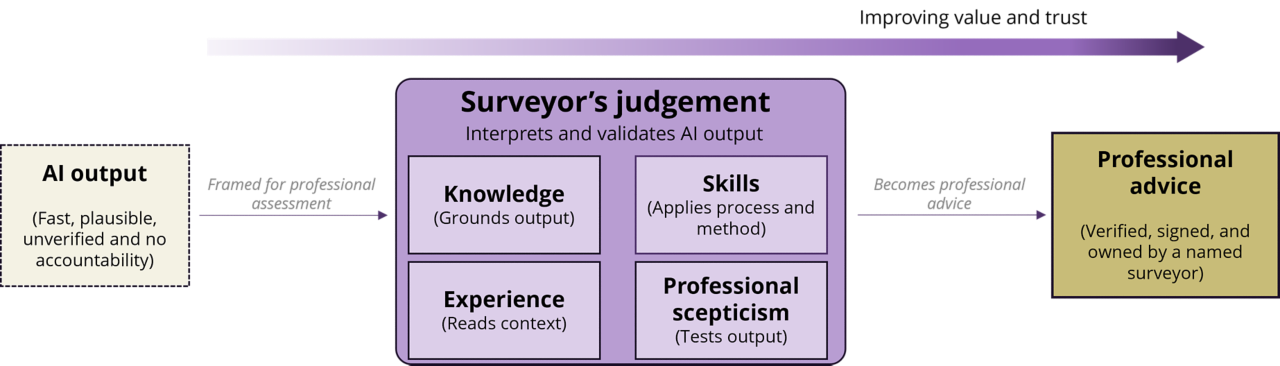
Figure 1: The surveyor's judgement elevates AI output into advice
Why judgement becomes more valuable as AI use increases
The surveyor’s judgement also enables the firm to fully benefit from the efficiency gains AI offers.
These gains are not simply the result of generating outputs more quickly. The full benefits of AI can only be captured when its outputs can be relied on by a client, a policymaker or an insurer. That reliance is made possible by the surveyor's documented judgement. Government guidance now states that the effectiveness and legitimacy of AI are constrained by the quality, structure and governance of the underlying data; judgement is what turns data into advice a client can act on.
As a recent World Economic Forum article observed, AI will keep getting faster and more capable. However, the value of its generated outputs depends on staying connected to trusted standards and accountable oversight. In surveying, professional judgement provides this trust and maintains the surveyor’s role as the trusted advisor. As AI moves from a tool the surveyor runs, to a chatbot the surveyor converses with, to an agent that takes the next step in a workflow on its own, the question of who is accountable for the result becomes more urgent.
Where AI automates or produces outputs at a high volume, the RICS standard accepts that scrutinising every output is neither necessary nor proportionate. However, it states that firms ‘remain accountable for each output’ and requires randomised checks to ensure quality. The surveyor remains accountable even as the work speeds up.
The risk of relying on unchecked AI outputs
The cost of not complying with the RICS standard and foregoing the surveyor's validation and verification is no longer hypothetical.
The use of AI without proper checking has produced a documented and growing problem. By early 2026, a widely cited public database of AI hallucination cases had catalogued more than 1,300 cases worldwide. These cases typically involve AI-generated material, often fabricated citations, submitted to courts – with sanctions escalating sharply. The pattern in these cases is consistent: a capable professional uses an AI system but fails to apply their judgement, taking no responsibility for verification and validation before submitting the output. The same database also notes disputes in the construction sector, including a matter before a US contract appeals board in which a party's brief was struck in its entirety after it was found to rely on AI-fabricated citations.
A recent article from ConsensusDocs (a coalition that develops construction contracts and documents) describes the verification of AI outputs as an emerging standard of care across professional fields, based on the principle that professionals remain responsible for AI-assisted work, regardless of which system produced it. The conclusion is clear: the technology does not remove the surveyor's duty to check the output, and it imposes significant risk on a surveyor who fails to comply. The professional and financial costs of non-compliance are likely to far exceed the costs of compliance.
The RICS standard outlines how a surveyor fulfils this responsibility by verifying AI-assisted outputs and earning the trust that enables a client to act on that advice. The surveyor tells the client in writing, before the work begins, when and how AI will be used, explains on request how an output was produced and assured, and ensures the client understands that professional judgement, not the AI system, is the basis of the advice.
What the standard secures for the profession
RICS developed this standard to place ‘the skill and experience of the professional surveyor’ at the core of how AI is used in practice. The driver behind this approach is simple: using AI irresponsibly ‘risks undermining and corroding the reputation of the profession’. The question is not what compliance with the standard costs; it is what the profession’s reputation is worth, and what it would cost to lose it. For firms and individual surveyors alike, reputation is the asset of most value to the clients.
A surveyor’s reputation is what makes AI-assisted work worth more than raw output from a system. It is why a client pays for a named professional’s opinion rather than running the model themselves. The long-term economic evidence on standards points the same way. According to a BSI study, organisations that adopt them tend to gain more than they spend, because standards make quality consistent and trust a centrepiece; and opportunities and rewards accumulate with trust. The RICS standard does the same for the application of judgement for AI outputs. It sets a consistent baseline so that a client can rely on the quality of any member's work.
What this means for the profession
The RICS standard secures the surveyor's role for the future, but it raises broader questions that it does not answer. Surveyors are already using AI across a range of activities, and use is increasing – although it varies by practice area, firm size, region and level of adoption – so where does the profession’s future value lie? What does this mean for professional judgement, accountability and the routes surveyors take to qualify and develop? RICS has already identified significant gaps in digital, data and AI-related skills that are affecting delivery and readiness. A core part of that competence will be understanding the AI systems the work relies on: what they can do, where they fail and when their outputs need to be challenged or overruled.
The direction of travel is becoming clearer. The profession's value will lie less in generating AI-based outputs and more in the judgement that interprets them and the accountability that supports them. RICS is addressing this shift through standards, guidance, qualification pathways and CPD, and welcomes suggestions and case studies from members and firms to help shape that work.


