
RICS in Europe - From Reliable Pasts to Volatile Futures: Rethinking Value under Climate Stress
-
 Email
Email
-
 Facebook
-
 Linkedin
-
 Twitter
-
 Whatsapp
07 November 2025
Rethinking asset value in a world shaped by climate change
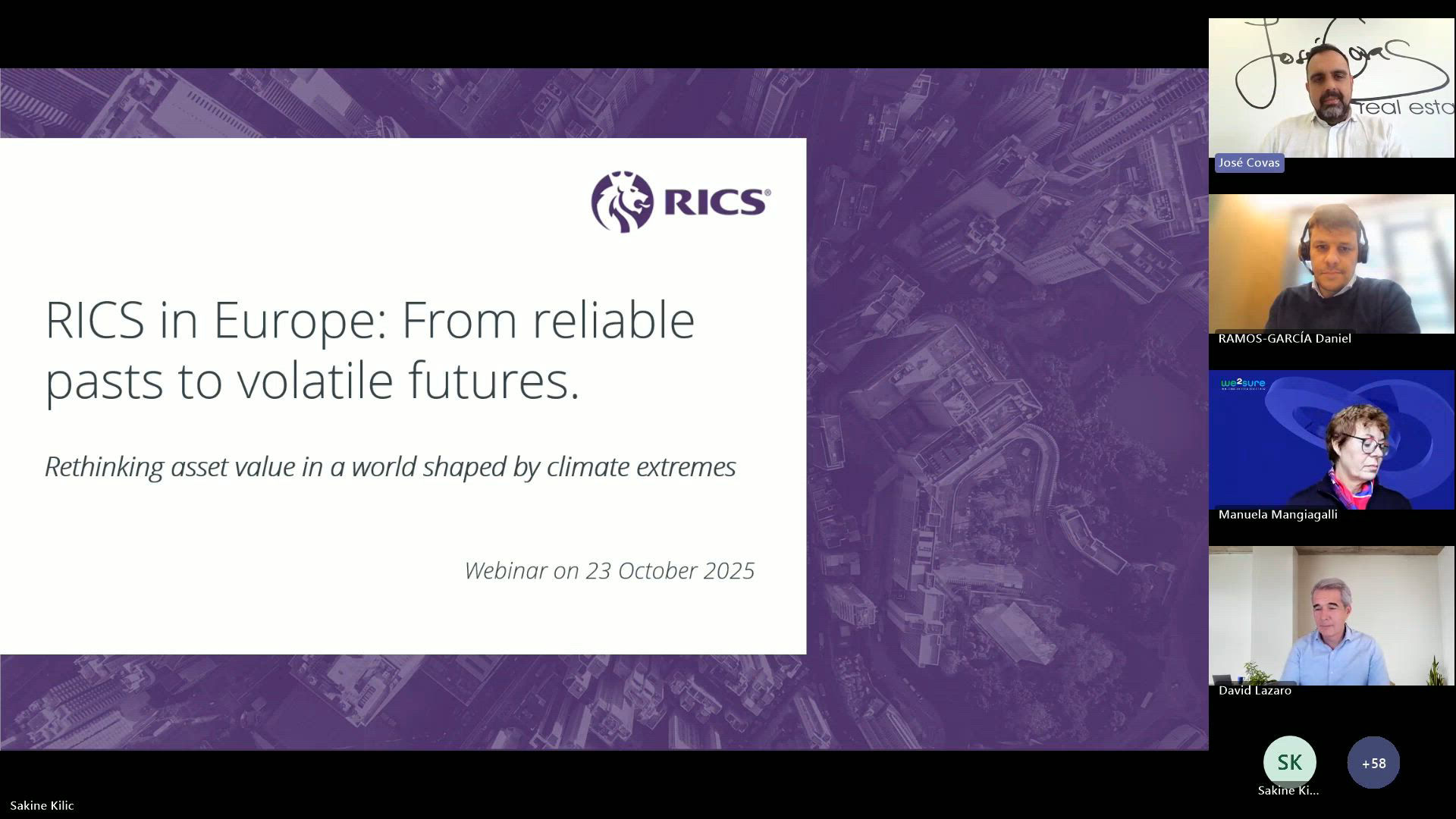
The growing reality of climate change is forcing our industry to reconsider how value is defined. In our webinar, “From Reliable Pasts to Volatile Futures: Rethinking Value under Climate Stress” experts from the banking, insurance and valuation sectors came together to discuss how climate-related risks are reshaping perspectives on asset value and long-term resilience.
Moderated by José Covas MRICS, Chair of the IVSC SRB ESG Working Group, the discussion brought together Manuela Mangiagalli, CEO and Co-founder of We2Sure, David Lázaro MRICS, Founder of Bluerise and Daniel Ramos-García, Climate Risk Officer at the European Investment Bank, who each offered a unique angle on how climate related risk are influencing investment decisions, regulatory expectations, and market behaviour.
David Lázaro MRICS opened the session with an overview of how climate risk is redefining traditional valuation thinking. Climate risk is reshaping asset values and what it means for investors and institutions. He outlined how physical impacts such as floods, heatwaves and droughts trigger wider transition and social risks that affect both markets and communities. True resilience, he said, is not about avoiding hazards but reducing vulnerability through better design, planning and adaptation. Using different socioeconomic pathways, he showed how different global scenarios, from sustainable to fossil-fuel-intensive, lead to diverging futures, challenging traditional valuation models. Citing Spain’s 2024 Valencia floods, Lázaro warned that risk assessments often underestimate exposure and urged valuers to integrate environmental data into underwriting. “We can’t eliminate risk,” he noted, “but we can manage it and in doing so, protect both assets and society.”
Building on this perspective, Manuela Mangiagalli, emphasized the critical role of insurance in connecting these insights to practical action. She explained that asset value depends on harmonized metrics across stakeholders, as exposure, vulnerability, risk, and resilience all shape financial and social outcomes. Using the example of a home in a flood-prone area, she showed how vulnerability can be minimized through adaptation and prevention, while insurance serves as a mechanism to transfer residual risk. She also noted that banks now face primary exposure through their loan portfolios, requiring a broader view of climate risk across entire holdings. Highlighting projects in Asia-Pacific, Mangiagalli illustrated how combined efforts from public and private investment, insurance, and resilience planning can protect communities, reduce migration pressures, and maintain long-term asset value.
Expanding on the financial perspective, Daniel Ramos-García from the European Investment Bank described how banks are uniquely positioned between asset owners and insurers, balancing long-term loan exposures with climate uncertainty. He explained that historical data alone cannot project future losses, so the EIB uses a two-step approach: 1) simplified screening with open-source data to identify relevant hazards, and 2), detailed, high-resolution analysis of asset-level risks to calibrate credit assessments. Ramos stressed the importance of considering correlated hazards, evolving socioeconomic factors, and timing differences across climate events. He also highlighted the difficulty of modelling extreme events like Valencia’s 2024 floods, whose probabilities may no longer reflect current realities, emphasizing the need for transparency, scenario analysis, and ongoing adaptation of frameworks, data, and reporting.
Together, the panel underscored that climate risk is not a distant abstraction but a present, multi-dimensional challenge, requiring collaboration, data innovation, and forward-looking strategies across valuation, insurance, and banking to safeguard both assets and communities. Asset value is no longer solely defined by location or traditional market factors; instead, resilience to climate extremes is becoming central. Both new developments and existing buildings must integrate adaptation measures, although retrofitting older stock often entails significant upfront costs. Solutions can be technological, nature-based, or a combination, with nature-based approaches offering cost-effective resilience while supporting ecosystem benefits.
A key challenge for investors and developers is balancing the costs of adaptation with profitability and ESG goals. The panel stressed the importance of strategic frameworks to determine which measures to implement, when to act, and how to avoid redundant or conflicting interventions. Coordination across stakeholders is crucial to manage local hazards, evolving regulations, and potential second-order effects on markets and communities. Insurance plays a pivotal role in this context, making resilience investments financially feasible and transferring residual risks. Customized insurance products can incentivize adaptation and retrofitting, while regulatory obligations and regional differences highlight the need for harmonized approaches and public-private collaboration.
The discussion underscored that addressing climate risk requires shared responsibility among investors, lenders, insurers, regulators, and communities. Early, proactive action reduces future regret and protects both financial returns and social outcomes.
Finally, the panel noted that the future of property valuation must evolve to reflect climate-related risks. Valuers need training, standardized methodologies, and reliable data to integrate physical, transition, and social risks into valuations. Forward-looking assessment of both direct and systemic impacts ensures that assets are resilient, markets are stable, and communities are protected.
For those who missed the live event, the full recording of “From Reliable Pasts to Volatile Futures: Rethinking Value under Climate Stress” is available on this page, offering further insights into how the profession can adapt to an increasingly uncertain future.