

Sustainability report 2026
-
 Email
-
 Facebook
-
 Linkedin
-
 Twitter
-
 Whatsapp
11 November 2026
The RICS Sustainability report 2026 explores how a sector that accounts for almost 40% of global emissions is responding to the challenges of the sustainability transition.
Now in its sixth year, the report conveys the attitudes of over 3,700 professionals covering a wide range of regions and specialisms.
It pulls in the results of two leading market surveys carried out by RICS, the Global Commercial Property Monitor and the Global Construction Monitor, to identify trends and sentiments in the property and commercial space.
Building on data from the RICS Sustainable Buildings Index, this year's report points to continued market appetite for sustainable buildings, with government policy found to be one of the most important enablers of investment.
It also exposes skills shortages in carbon measurement and highlights the sector’s growing focus on resilience in response to immediate climate risks. The findings underline the need for greater professional capability, clearer standardised frameworks and continued government policy support in order for the wider industry to meet sustainability ambitions.

Demand for green real estate stays steady
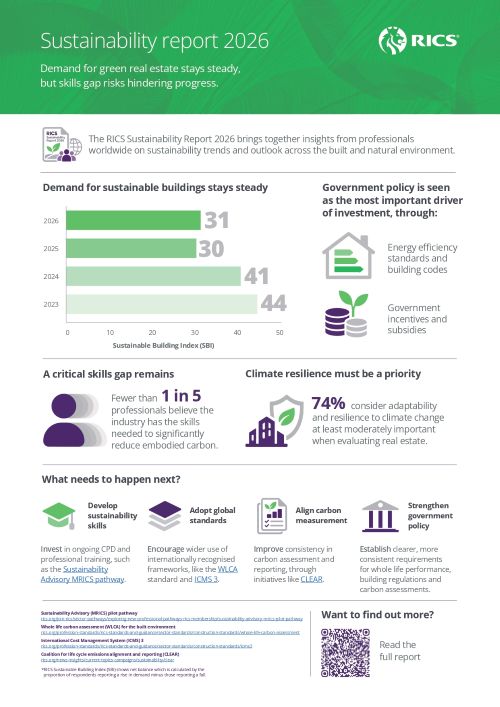
Download our explainer infographic to gain critical regional insights and explore the impact of government policy, skills training, measurement methods and more on how sustainability is approached across the sector.
Published date: 11 November 2026
“The 2026 Sustainability report shows progress alongside continuing challenges across the sector. The next step is to build on this progress by adopting effective practices more widely across the sector as the decisions we make today will shape the resilience, sustainability and value of the built and natural environment for generations to come.”

Nicholas Maclean
RICS President and Chair of Governing Council
Key findings from the report
Market appetite continues
Global demand for sustainable buildings has remained steady. The regions with the greatest demand, measured by the RICS Sustainable Building Index (2026), were Europe (+51) and MEA (+44).
Skills shortages are holding us back
Less than 20% of respondents believe professionals have the necessary skills to reduce embodied carbon to a large extent.
Regulation is driving investment
The top three drivers of investment in sustainable buildings are regulatory energy efficiency standards and building codes, government incentives and subsidies, and a perceived increase in asset value.
Skills shortages are holding us back
Less than 20% of respondents believe professionals have the necessary skills to reduce embodied carbon to a large extent.
What happens next?
We use the report's findings to make several recommendations, including the following.
Find out more in the report, including how they can be implemented.
Strengthen policy to accelerate decarbonisation
Advance consistent carbon assessment through global standards
Build the skills needed for a sustainable transition
Accelerate progress through collective action
Global Sustainability Conference 2026
03 December | 07:30 – 17:00 GMT | 6.5 hours CPD
Save 30% with discount code: GCSUST202630
At this year’s Global Sustainability Conference, we will explore the report's findings in greater depth through real-world case studies that bring its principles and recommendations to life.
From embedding biodiversity considerations into project assessments to addressing the sustainability skills gap, attendees will gain practical insights, learn from peers and access insight to help deliver nature-positive outcomes and support a more sustainable built environment.
To support your professional development amid evolving standards, growing skills demands and changing market expectations, we're offering a 30% discount from now until the conference starts.


