

AI in commercial property and construction report 2026
-
 Email
Email
-
 Facebook
-
 Linkedin
-
 Twitter
-
 Whatsapp
18 August 2026
Authors
Tom Storey MRICS, Anil Sawhney FRICS, Katherine Pitman
Foreword
“A year ago, this report described an industry approaching an inflection point. The conditions for AI to take hold were in place, but adoption itself was still limited. This year’s data shows that point has been crossed. This shift matters, as does the responsibility that comes with it. RICS’ professional standard Responsible use of artificial intelligence in surveying practice, which came into effect in March 2026, provides members with a well-defined framework for acting with confidence. This is the moment for the profession to lead, not follow.”

Maureen Ehrenberg FRICS CRE
President Elect, RICS
1 Introduction
The field of AI is advancing rapidly. Since the 2025 report, the capabilities of foundation models have improved, and AI features have been built into software that surveyors already use daily. These developments have lowered the barrier to entry for using AI, and the survey data appears to reflect this.
The rules surrounding AI have developed as well.
- The EU’s AI Act began its staged implementation starting in 2025.
- In the UK, the Building Safety Act gateway regime has increased the documentation required on construction work.
- In March 2026, the RICS professional standard Responsible use of artificial intelligence in surveying practice (‘the RICS AI standard’) came into effect. This has given members and firms a framework for using AI in professional work.
1.1 What does this report do?
This report draws on responses from more than 3,100 chartered surveyors and other professionals working in construction and commercial property worldwide. For the first time, it brings the two sectors together, allowing readers to see where they overlap and where they differ. It presents the results of two surveys conducted as part of the RICS Q1 2026 Global Commercial Property Monitor (GCPM) and Global Construction Monitor (GCM). For GCM, it also compares this year’s findings with the findings published in 2025.
This report seeks to answer the following question:
What is the current state of AI use across the construction and commercial property sectors, and how has it changed in the past year for construction?
The Q1 2026 data show that around two-thirds of GCM respondents now use AI in some part of their work, up from just over half a year earlier. Commercial property, surveyed at this scale for the first time, shows a sector that is further along, with more than three-quarters of respondents reporting some level of AI use.
Movement of this size over 12 months is significant, but adoption levels are still increasing. In both sectors, the most common stage organisations are at is the early-stage pilot, with embedded use remaining rare. More organisations plan to invest in AI than have already moved a pilot into routine practice; the gap between intent and deployment has not closed. What has changed is where the gap sits:
- In 2025, it was the distance between planning to invest and starting.
- In 2026, it is the distance between running a pilot and embedding it.
Two things set this year’s report apart from last year’s:
- The inclusion of commercial property: respondents to the Q1 2026 GCPM were asked broadly similar questions about AI use as the GCM, allowing the report to compare the two sectors at the global level.
- GCM can now be compared with its 2025 results, giving the first year-on-year view of how the sector is changing around the use of AI.
A combined view of both commercial property and construction sectors matters because AI is not confined to one surveying practice area. Members working in land and natural resources, valuation, project management, quantity surveying, building surveying, residential and commercial property and asset management are encountering the same underlying technology. They have the same questions about governance, risk and the use of the RICS AI standard. This report highlights where the two sectors differ – and where they are the same, members in either sector can read the findings as their own.
2 Survey and responses
To assess the current state of AI use across the construction and commercial property sectors, members responded to GCM and GCPM to share information about their organisations’ AI use, preparedness, perceptions and plans.
2.1 What we asked
GCM respondents were asked about:
- their organisation’s current level of AI adoption in construction projects
- how prepared their organisation is to implement AI solutions
- how significant they believe AI could be in improving various aspects of their projects
- their organisation’s primary barriers to AI adoption
- the emerging areas in which they expect AI to have most impact over the next five years
- their organisation’s AI investment plans for the next 12 months
- how far their organisation’s AI use mirrors the RICS AI standard, and
- the productivity gain they expect from AI over the next 12 months (UK respondents only).
The final two questions are new for 2026.
GCPM respondents were asked a set of five questions covering:
- current AI use
- investment plans
- primary barriers
- applications expected to have the most impact over five years and
- alignment with the RICS AI standard.
These broadly match the GCM questions, which allows the two sectors to be compared at the global level. Where the surveys differ in wording or in the options offered, the report shows each sector separately.
2.2 Who responded
GCM received 1,883 responses and GCPM received 1,265, for a combined sample of 3,148. Responses to the two surveys varied by region.
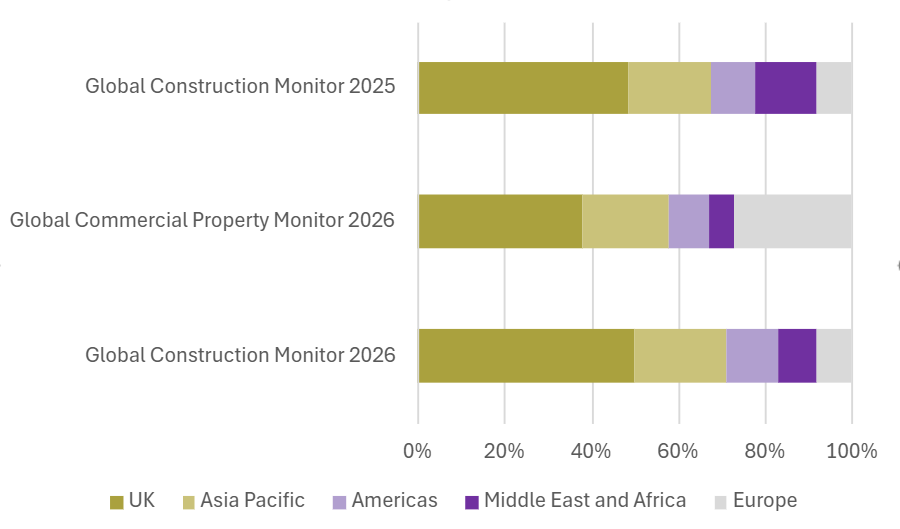
To ensure the UK results do not disproportionately skew the results when represented at a global level, a weighting of 0.04 was applied to UK results, while the remaining responses were combined at weighted 0.96. The 2026 global figures are the average of the five regional results, so each region carries equal weight regardless of its sample size. Where weighting matters to a particular finding, the report highlights it.
2.3 How the data was analysed
All survey questions and response options were designed to reduce sentiment, social and response biases. Responses were analysed using a spreadsheet tool to compare GCM and GCPM results and identify shared and contrasting patterns at the global level. A year-on-year comparison is shown for GCM only, since this is the second annual cycle for GCM and the first for GCPM. The GCPM results should therefore be read as a baseline against which later cycles can be measured.
The report presents data at regional levels in only two places:
- the year-on-year movement in UK construction, which sits within a uniquely strict UK regulatory environment, and
- the productivity question, which was asked only of UK GCM respondents.
All other figures are global unless stated otherwise.
3 Survey results
This section presents the results in question-by-question format.
3.1 Construction: ‘no AI implementation yet’ plummets
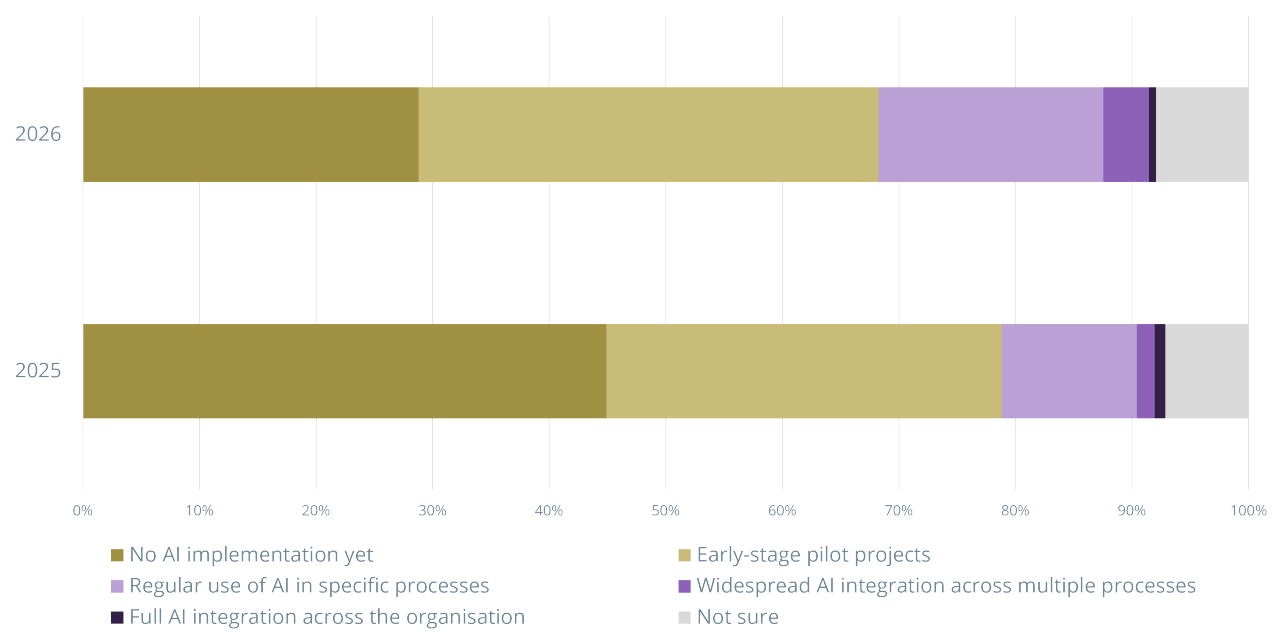
Figure 2 shows that since 2025 there has been a sharp decline of over a third in organisations reporting no AI use. Early-stage pilots rose 5%, and regular use of AI in specific processes increased by over half, from 12% to 19%. Wide-ranging integration across multiple processes remains rare, and full integration across the organisation accounts for less than 1%.
The fall in no AI use is the largest movement in the GCM data, and three factors are likely to be causing it.
- The cost of trialling AI fell sharply through 2024 and 2025, as model pricing dropped and AI chatbots were integrated into web browsers and operating systems, lowering the barrier to entry. Markets with strict documentation requirements for construction have been affected.
- The large software platforms used across the built and natural environments have introduced AI features into existing subscriptions, allowing organisations to gain AI capabilities without making a separate purchasing decision.
- The UK, under the Building Safety Act gateway regime, has seen extra compliance work created, a clear early use case for AI systems.
The movement has been from no AI use into piloting and limited regular use, rather than into embedded operation. This suggests a cautioned approach, with firms taking things slowly by trialling rather than skipping a trial and buying into full use straight away.
The UK pattern within the global picture is striking. In 2025, the UK was the most cautious region, but in 2026 there was a 17% reduction in no AI use – the largest of any region. Meanwhile, regular use in the UK almost doubled. Although the UK remains the most cautious region in absolute terms, the gap is closing.
3.2 Commercial property has seen more adoption
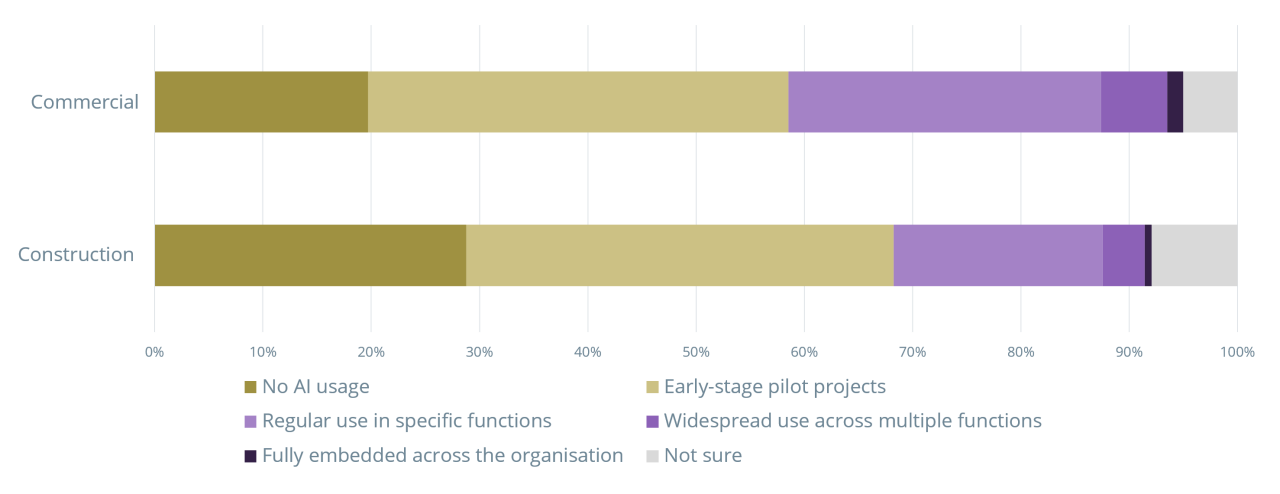
Figure 3 suggests that commercial property is further ahead in AI adoption than construction. Fewer organisations reported no AI use, while regular use was notably higher and widespread adoption was also more common. However, the percentage of organisations running early-stage pilots was identical across both sectors. This suggests that although commercial property is currently ahead, both sectors are exploring AI at a similar rate.
Compared to GCM, fewer respondents reported no AI use and regular use was much higher, as was widespread or full use. However, pilot activity was identical. The difference between the sectors is therefore not whether they are piloting AI; it is whether their pilots have become routine use.
One factor that helps explain GCPM’s position is software. The software used in commercial property work, covering portfolio management, valuation and asset analysis, had built-in AI features ahead of the equivalent construction tools, so GCPM respondents could access AI capabilities through subscriptions they already held.
3.3 Construction hasn’t moved much at all
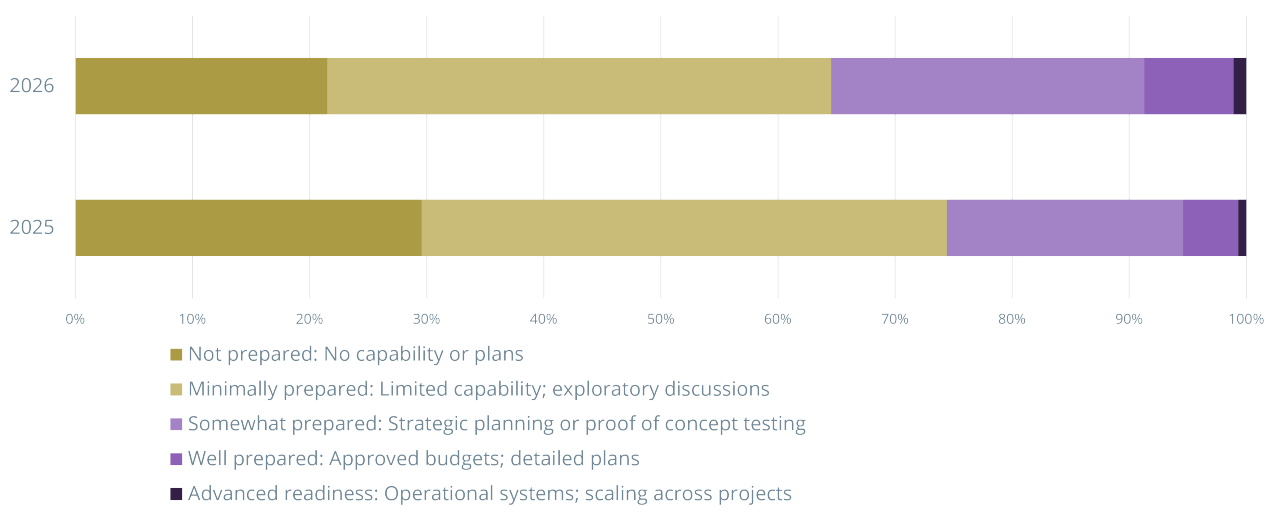
Figure 4 shows that organisational readiness remains at an early stage, with almost two-thirds of respondents reporting that their organisation is either not prepared or only minimally prepared for adoption. While preparedness remains low, the picture has improved since 2025. This has been driven by a reduction in organisations reporting no preparedness at all. In contrast, the proportion describing themselves as only minimally prepared hasn’t changed. This suggests that many organisations have started their AI journey but have yet to build the capabilities needed for more mature adoption. Advanced readiness, with operational systems being scaled, remains extremely rare.
This follows the same trend as adoption: respondents have moved away from ‘no engagement’, but mostly into the next category up rather than into substantive readiness – the preparedness equivalent of the pilot-stage adoption position.
3.4 GCM respondents see AI’s value concentrated in operational areas
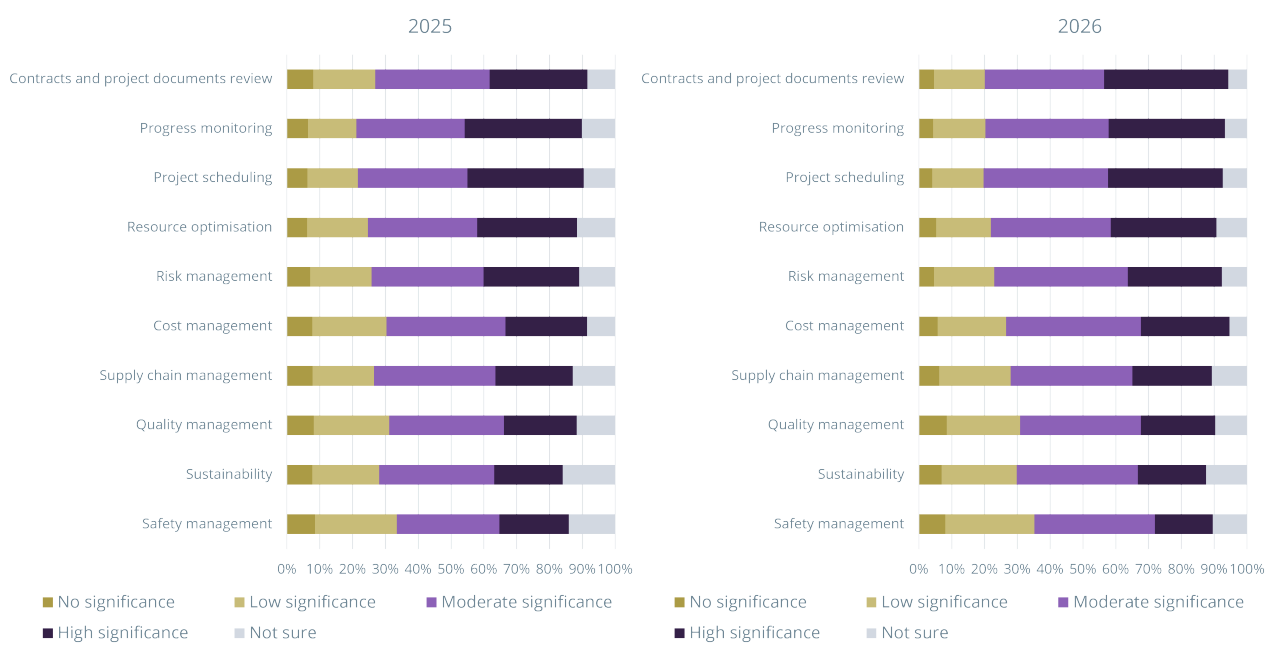
The results mirror 2025, and are more telling when high significance is separated from moderate. In general, more respondents rate AI as moderately significant than highly significant. This is consistent with a wider shift from early enthusiasm to measured engagement, as respondents who have piloted AI have formed a clearer view of what it can and cannot yet do.
3.5 Construction barriers are staying the same
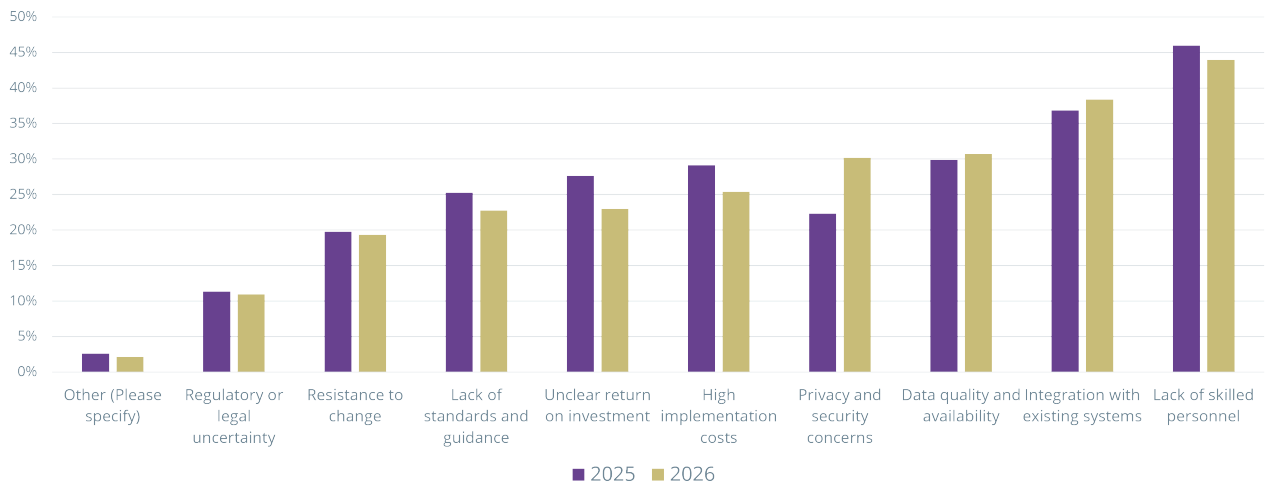
When analysing the primary barriers to AI adoption, the top three remained the same as in 2025. However, two changes should be highlighted:
- Privacy and security concerns rose, from 22% to 30%.
- High implementation costs fell, from 29% to 25%.
The cost of using AI tools dropped sharply throughout 2024 and 2025, and AI features were bundled into software that many organisations were already paying for. Respondents’ sense of AI costs appears to be catching up with the reality that trialling it costs much less than it did a year ago.
The rise in privacy and security concerns may be linked to increasing use. As more organisations move from no engagement to pilots, and from pilots to regular use, they face data handling questions that earlier-stage organisations have not yet faced. The EU AI Act came into force in August 2024, with its provisions rolling out in staggered phases between 2025 and 2028. It raised the visibility of AI-specific privacy and security duties, particularly for organisations working in European markets. Resistance to change fell marginally while regulatory uncertainty remained stable; it seems that as adoption matures, the practical complications of deploying AI become more visible.
3.6 Commercial property faces different barriers
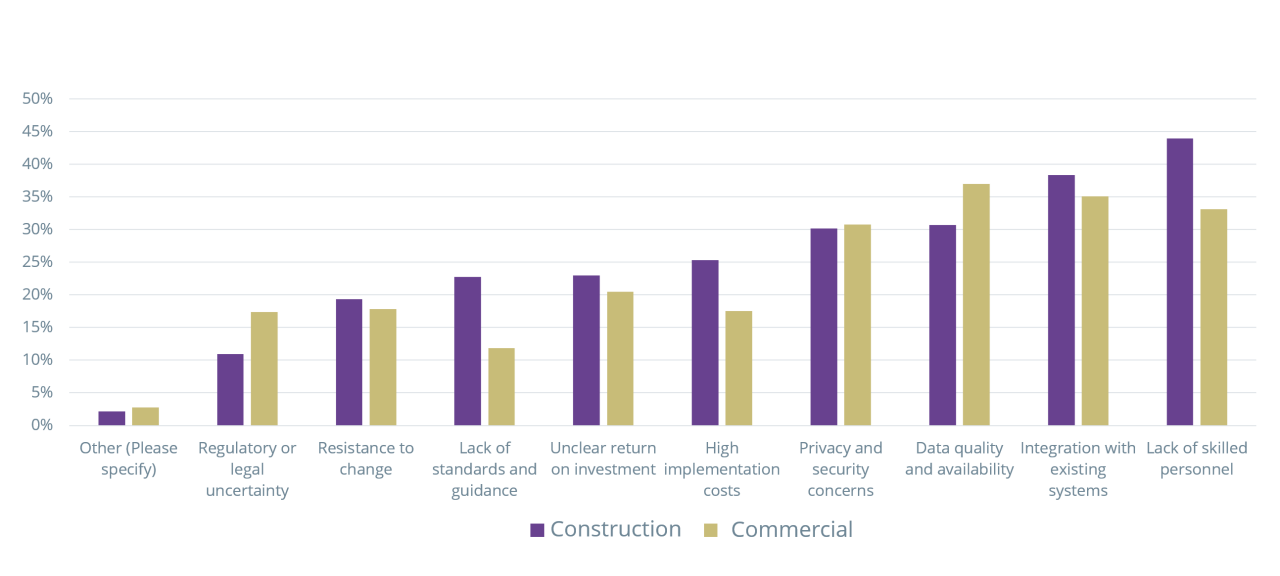
At the sector level, the barriers cited by GCPM and GCM respondents differ. While a lack of skilled personnel is the most-cited barrier in GCM, it is only the third-most-cited in GCPM, behind data quality and availability, and integration with existing systems. On most other barriers, GCM also reports higher figures.
GCPM leads on only two barriers, both revealing: data quality and availability, and regulatory or legal uncertainty. The pattern consistently shows each sector at a different point on the adoption journey:
- GCM’s leading barriers are capability barriers: the people, the integration and the standards a sector needs to get going.
- GCPM’s two leading barriers are those a sector faces once it is already deploying at scale: the quality of the data feeding its analytics, and the unresolved question of how AI is treated when it is used for regulated professional activity.
A point of context is relevant here. GCM data resets at each project boundary and is produced by many firms to varying standards across the built environment. Commercial property data is largely portfolio-based and held by a single firm or repository. That difference is consistent with the survey’s barrier gaps and is unlikely to close quickly.
3.7 Expected five-year impact: continuity in construction and contrast between sectors
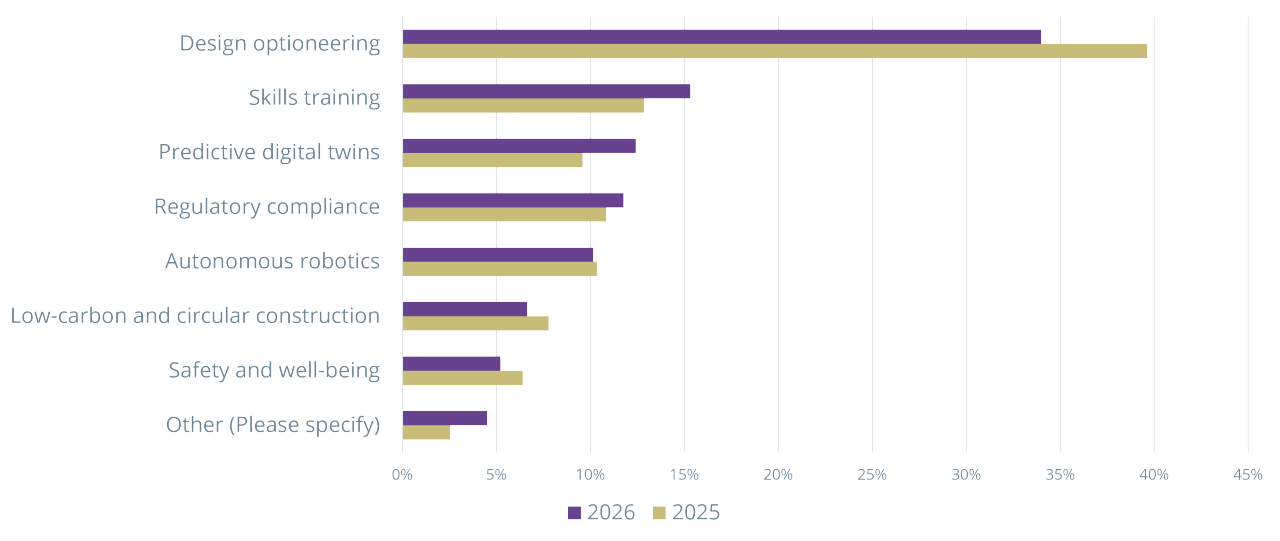
GCM respondents expected AI to have the most impact on design optioneering, although the percentage dropped from 2025. Regulatory compliance was one of the most selected areas after design optioneering, with UK respondents selecting it over twice as often as respondents from other regions. This is consistent with changes to the compliance environment around UK construction, with the Building Safety Act gateway regime, the Future Homes and Buildings Standards and carbon reporting all increasing reporting requirements in a short space of time.
Safety and well-being, and low-carbon and circular construction remain at the bottom of the rankings, as they were in 2025. Respondents see neither immediate significance nor longer-term impact for AI in the areas where obligation is rising fastest.
The results for GCPM reveal a different picture. The applications most often chosen were completely different to GCM.
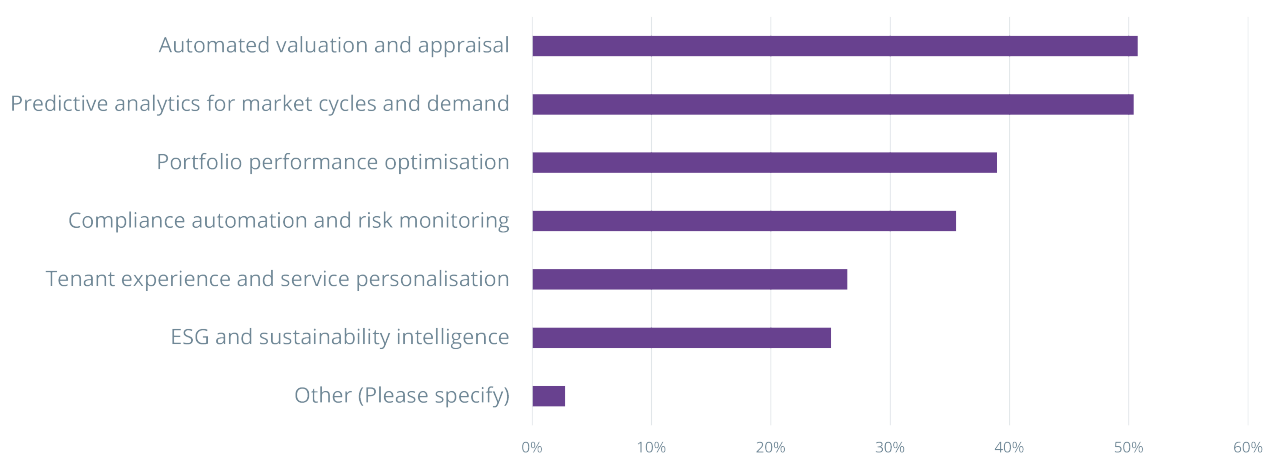
Because the two surveys offered different options, the lists cannot be compared directly, but their results are still insightful.
GCPM’s top expected applications are decision-support tools that help professionals with valuation, market analysis and portfolio choices. GCM’s top application is a generation tool, design optioneering, where AI produces options for a professional to judge. Compliance automation appears near the top of both lists, so read across the two surveys, the application both sectors recognise most consistently is AI applied to compliance work.
3.8 Construction investment intent has settled into ‘maintain’
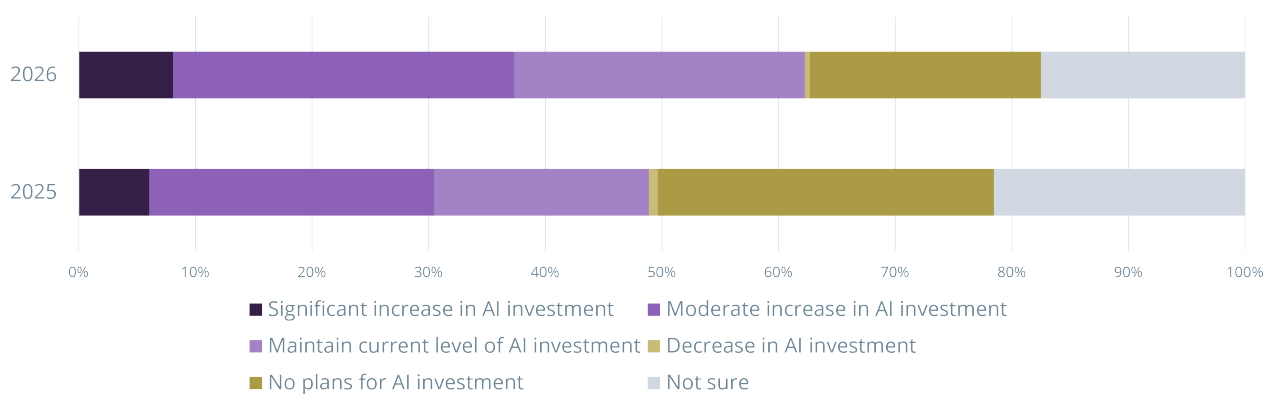
The combined picture is one of measured commitment. Most respondents plan either to maintain their AI investment or to increase it moderately, while around a quarter still have no plans and few expect a significant increase. Almost none plan to reduce investment. Alongside the rise in pilot activity, this suggests that many organisations that have moved out of ‘no engagement’ are investing steadily rather than committing to rapid expansion. The strategic ambition reported in 2025 has not yet been converted into substantial new spending at the same rate.
The UK remains the most cautious region. UK respondents with no plans to invest stood at 35%, down from 44%, but still the highest of any region, while those anticipating a significant increase remained the lowest at 5%.
3.9 Commercial property is weighted more toward increased investment
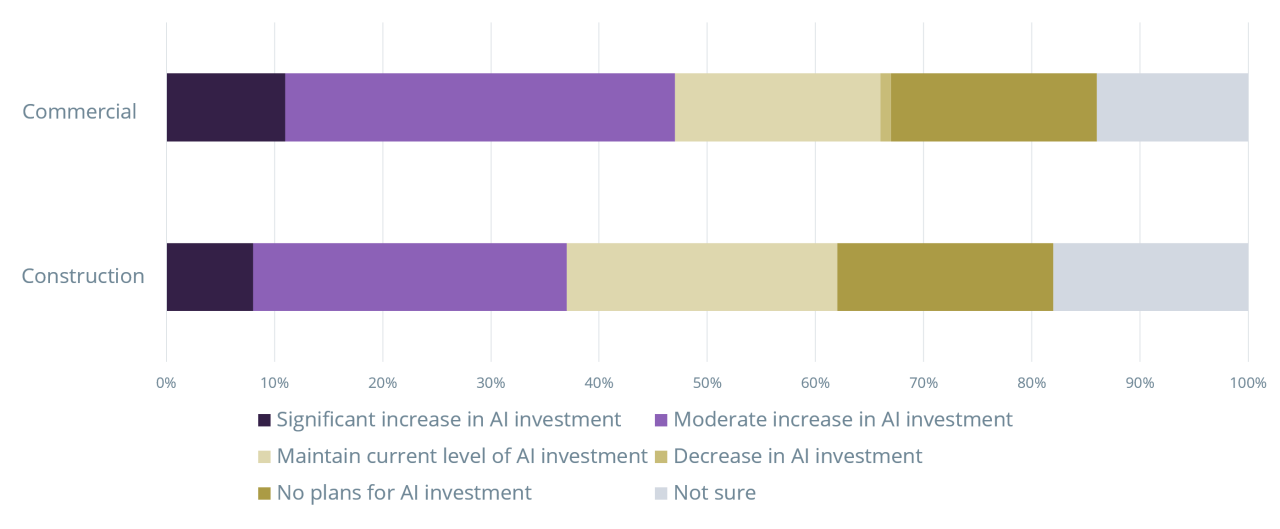
Commercial property is more inclined to increase its AI investment than construction. In GCPM, 47% of respondents plan to increase investment, against 37% in GCM – a gap of about 10 percentage points.
However, in general the picture is not one of reduced investment. It is one in which the great majority in both sectors are at some stage of engagement, while a persistent minority – around a quarter in each sector – are not yet part of the investment conversation at all.
3.10 Awareness of the RICS AI standard varies across both sectors
Both surveys asked how far respondents’ organisations conform to the RICS AI standard. The question is new for 2026, so has no year-on-year comparator.
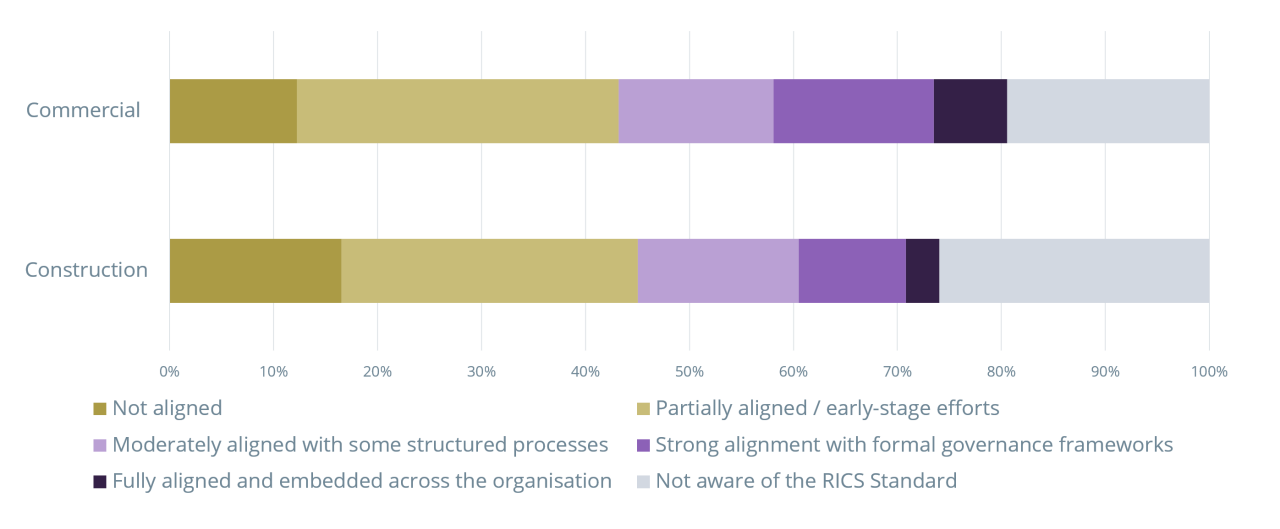
In total, 43% of GCM respondents and 32% of GCPM respondents are not currently aligned, whether by lack of awareness or current misalignment. At the other end of the scale, combined strong and full alignment stood at 14% in GCM and 22% in GCPM. The single largest group in both sectors was ‘partially aligned/early-stage efforts’.
The most significant part of non-alignment is lack of awareness rather than continuing misalignment. In both sectors, the percentage that are unaware of the standard is larger than the percentage that know about it but have not yet conformed with it. The most direct way to close the conformation shortfall is therefore to extend the standard’s reach rather than address active resistance to it.
3.11 UK productivity expectations
UK GCM respondents were asked a productivity question in the Q1 2026 survey. It has no equivalent in the GCPM survey and was not asked of GCM respondents elsewhere, so Figure 13 cannot be compared regionally or globally.
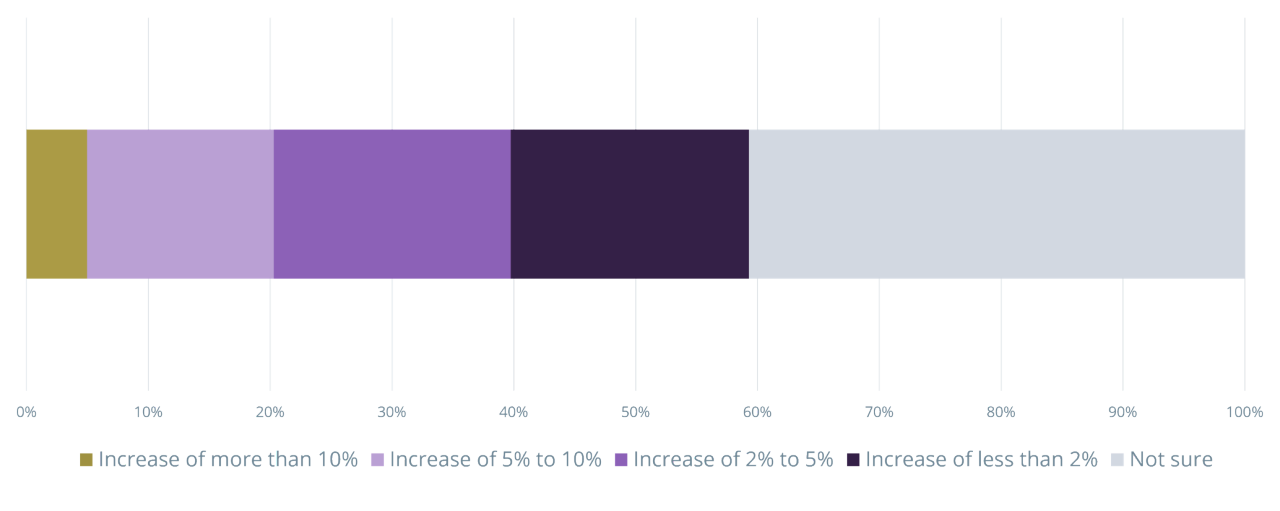
The dominant ‘not sure’ response corresponds to the wider UK picture. Respondents whose organisations have only recently moved out of ‘no AI’, and remain mostly minimally prepared, do not yet have the deployment experience on which to base a productivity forecast. The honest reading is that UK construction has not yet formed a view on this topic.
4 Analysis
This section highlights the pinpoints where two or more findings combine to tell a clearer story than either alone, drawing on year-on-year movement in construction and sectoral comparison.
4.1 Ambition continues to outstrip present capability
The 2026 data shows that investment intent in both sectors outpaces adoption. In GCM, around 37% of respondents plan a moderate or significant increase in AI investment, which rose from 30% in 2025, but only around 4% currently report widespread or full integration. The gap in GCPM is even wider: around 47% plan to increase investment, compared with around 6% reporting widespread use. Both sectors show a measured approach, with respondents planning to invest rather than develop plans through to widespread deployment.
Section 3.5 suggests that barriers may be limiting organisations’ ability to translate investment intent into adoption. Construction respondents reported largely unchanged barriers from 2025, while privacy and security concerns increased in importance.
4.2 The pilot-to-production gap is the challenge
The 2026 data shows a change that couldn’t be reported for 2025. Globally, GCM and GCPM are piloting AI at the same rate (39%), but they differ in conversion. GCPM shows regular use at 29%, higher than GCM’s 19%, with combined widespread or full use at 6% against 4%. The gap is in whether pilots are converted into routine practice.
Certain organisational factors help explain the faster conversion shown in GCPM. Commercial property data has been adopted at the portfolio level, making it a recurring practice. This gives tools that pilot well a continuous foundation to embed across assets. Its income also recurs across asset cycles, allowing AI investment to compound, whereas construction’s project-by-project income requires each investment to prove itself on an individual job. Additionally, construction data resets at each project boundary and conversion must be repeated.
For members in either sector, the threshold to start a pilot has fallen sharply and in tandem; on the other hand, the threshold to embed processes post-pilot has not been as achievable in construction as it has for commercial property.
4.3 Respondents undervalue AI where obligation is rising fastest
The 2025 GCM report highlighted low expectations for AI in sustainability and safety. These are areas where professional and regulatory obligations continue to increase. The 2026 data reinforces this across two questions.
- In terms of significance, safety management and sustainability are again the lowest ranked.
- On expected five-year impact, safety and well-being, and low-carbon construction, are again at the bottom.
Two factors are likely at work here:
- AI in safety-critical work needs integrated data, real-time supervision and clear accountability, which are not yet consistently in place.
- The accountability frameworks around these outcomes have not yet adapted to AI.
Members working in these areas may benefit from examining the gap between professional instinct and the use cases emerging in safety and sustainability practice – before others close that gap for them – and consider where professional instinct connects with emerging AI applications in safety and sustainability. This involves moving beyond general awareness and engaging with specific tasks enhanced by AI.
Although the risks need to be managed, the danger of inactivity is that the future direction of innovation will be set by others. Adoption isn’t just a productivity issue; it questions professional relevance and influence.
4.4 The skills constraint has become operational
A lack of skilled personnel remained the most-cited barrier in both surveys, although it is noticeably more cited in GCM. That it is felt in both sectors, but more keenly in the sector further along the adoption curve, is consistent with the idea that skills problems become visible only once deployment reaches the point where a shortage constrains what an organisation can do next.
A specific part of this finding merits addressing directly. Among the GCM free-text responses, one respondent wrote that they were ‘concerned the younger newly qualified are already making use of AI, but implementing and blindly trusting it’, and another that ‘AI could impact the ability to develop graduates’.
The two points are connected: AI tools are now widely available to recently qualified professionals, at the point in their careers where they have the least professional experience to be able to accurately assess the value of what AI produces. The skills constraint is therefore not only about building AI competence, it is about building the professional judgement to assess AI-generated outputs.
This links directly to the RICS AI standard, which clearly assigns responsibility for AI-assisted work to a named surveyor. For firms developing junior staff, embedding the standard’s principles regarding supervision and CPD is one way to ensure the skills constraint does not become an issue of professional integrity.
4.5 Risk awareness has increased in step with adoption
Privacy and security were only middle-ranked barriers in 2025, suggesting that limited real use or exposure might be a factor. In 2026, they showed the biggest increase, while smaller rises in resistance to change were also noted. The picture is consistent: as organisations move from no engagement to pilots, then from pilots to regular use, they encounter operational complications that organisations further behind on the adoption journey have not yet faced. The 2025 report anticipated this, and noted that such lower-ranked barriers would become more important as adoption increased.
4.6 A persistent minority remains outside the conversation
In both sectors, around a fifth of respondents reported no plans to invest in AI over the next 12 months, and only around 1% in either sector plan to retreat from AI use. The picture is not one of disillusionment; it is one in which most respondents engage at some level, while a persistent minority does not. These organisations’ members or employees will still encounter AI through their clients and markets, even if their own organisations do not deploy it. Therefore, the case for engaging with the RICS AI standard applies to them as much as to anyone.
4.7 Extending the RICS AI standard’s visibility is the most direct route to alignment
Across both sectors, the most common reason for non-alignment with the RICS AI standard is lack of awareness, rather than total misalignment. Some 26% of GCM respondents and 19% of GCPM respondents were unaware of the standard’s existence, both of which were larger than the percentage aware but not aligned. Among organisations that are aware of the standard, partial alignment is by far the most common position, which suggests the standard is being engaged with on its merits where it has reached its audience.
The implication is clear: the most efficient way to close the alignment shortfall is to bring the standard into the working environments of surveyors who do not yet know it exists, through the channels members already use for CPD and networking.
5 Recommendations
The survey results describe a profession still grappling with the implementation of a disruptive new technology. AI use has grown materially over the past 12 months, but the conditions for pilots to become embedded into practice are not yet fully in place. Supporting that phase requires actions from both industry and RICS, set out below across the same three time horizons as in the 2025 report.
5.1 Immediate actions
Table 1 sets out the immediate actions for 2026–27. The report findings suggest that organisations are still moving from pilots to operational use, which makes governance and professional judgement a key focus for the next phase of adoption.
The actions highlight that responsibility is shared between RICS and the wider industry. Organisations need to embed responsible AI practices outlined in the RICS AI standard, while RICS supports adoption through standards, guidance and industry engagement. The result should be greater confidence across the industry that AI is being used responsibly.
Table 1: Immediate actions (2026–27) | |
Leadership by industry | Support by RICS |
Read the RICS AI standard and assess current or planned AI use against it, particularly where AI informs client-facing work. | Extend awareness of the RICS AI standard into channels reaching every surveying discipline, with sector-specific examples. |
Plan from the outset how a pilot will become routine practice, defining the data, integration and supervision it will need. | Relaunch the Tech Partner Programme, building relationships with technology partners under a shared expectation of alignment with the RICS AI standard. |
Document AI involvement in deliverables, including the tools used, the data they ran on and the points of human review. | Publish practical guidance on AI use cases drawn from across the membership, showing both effective deployment and responsible governance. |
Use enterprise tools rather than consumer-grade AI for work involving client data, in line with the RICS AI standard’s data stewardship principle. | Deliver CPD on the RICS AI standard, and on practical AI competence for chartered surveyors at all career stages. Build on the Data Analytics and Intelligence (MRICS) pathway so that the capability developed through the pathway remains current as technology and standards evolve. |
Set clear AI use protocols for recently qualified staff, who may start using AI tools before they have the experience to judge the output. | Work with industry bodies in both sectors to coordinate RICS AI standard-aligned guidance and reduce duplication. |
5.2 Medium-term actions
Table 2 focuses on the next stage of maturity, where organisations move from successful pilots to scaled deployment. This period highlights the shift from establishing foundations to embedding AI at an organisational level.
With the foundations in place, organisations apply AI at scale under the governance framework provided by the RICS AI standard, while RICS develops sector-specific guidance and embeds AI competence into surveying qualifications.
Table 2: Medium-term actions (2028–29) | |
Leadership by industry | Support by RICS |
Build AI competence into firms’ CPD, including for staff in safety, sustainability and other areas where AI raises specific professional questions. | Develop sector-specific extensions of the RICS AI standard for valuation, quantity surveying, building surveying and project management. |
Build the capability to convert pilots into production, including data quality, integration patterns and supervision, which then lets successful pilots scale. | Evolve the Tech Partner Programme into a structured framework that helps members evaluate tools against the RICS AI standard. |
Embed explainability, fairness and human-oversight protocols into client-facing AI work, particularly where outputs affect safety, cost, valuation or compliance. | Embed AI competence into the APC and CPD frameworks, with the Data Analytics and Intelligence (MRICS) pathway providing the structured route to membership through APC, and continuously through CPD. |
Develop oversight for AI-assisted work, including audit trails and accountability that can be evidenced to clients and regulators. | Gather case studies from across the membership, with attention to currently underused safety and sustainability applications. |
5.3 Long-term actions
Table 3 looks beyond adoption towards long-term transformation. The focus shifts to scaling proven AI applications across the profession.
Standards and governance integration across sectors and markets will ensure professional capability continues to evolve alongside technology. Industry will play a central role in demonstrating the benefits of responsible AI use, while RICS supports the profession through evolving standards and international collaboration.
Table 3: Long-term actions (2030 and beyond) | |
Leadership by industry | Support by RICS |
Scale successful AI applications across functions, projects and geographies, contributing evidence of success to the wider profession. | Continue to evolve the RICS AI standard in step with the technology and with adjacent regulatory frameworks. |
Contribute to cross-sector frameworks covering professional practice, procurement, life cycle assessment and regulatory alignment. | Co-develop cross-sector AI frameworks with peer professional bodies, so members work within consistent governance. |
Demonstrate the gains in productivity, social value and environmental performance from responsible AI use. | Host regional and international exchanges to support shared understanding across markets at different stages of adoption. |
Make skills gaps known to RICS.
| Integrate AI into surveying competencies so the profession’s capability scales with the technology. |